


Comment observer les migrations de charges ?
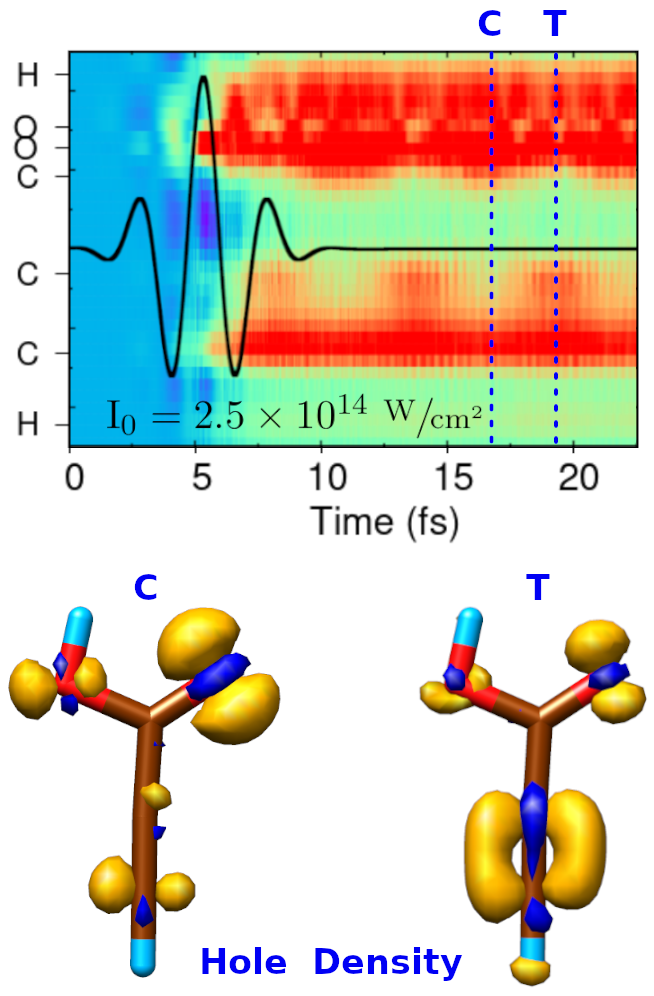
Clément Guiot du Doignon, Rajarshi Sinha-Roy, Franck Rabilloud et Victor Despré (équipe Physico-chimie théorique) ont publié un article intitulé "Correlation-driven charge migration triggered by infrared multi-photon ionization " dans la revue Chemical Science.La technologie attoseconde permet d’explorer les dynamiques électroniques à leur échelle de temps caractéristique. Les migrations de charge, dynamiques purement électroniques et ultrarapides, en constituent un exemple marquant, longtemps inaccessibles sans ces outils. Un cas clé est celui des migrations de charge corrélées, qui n’existent qu’en présence de corrélations électroniques et révèlent des effets complexes. Leur étude demeure toutefois un défi majeur, tant sur le plan expérimental que théorique. Les auteurs proposent une approche efficace en identifiant les situations où la TDDFT peut prédire de manière fiable ces dynamiques. Ils montrent qu’elles peuvent être déclenchées sélectivement par l’ionisation de molécules au moyen d’un laser infrarouge intense et suggèrent un schéma expérimental combinant ionisation par champ intense et résolution spatiale offerte par les XFELs.
How to observe charge migrations?
Clément Guiot du Doignon, Rajarshi Sinha-Roy, Franck Rabilloud and Victor Despré (Theoretical Physicochemistry team) published an article entitled "Correlation-driven charge migration triggered by infrared multi-photon ionization " in the journal Chemical Science..Attosecond technology makes it possible to explore electronic dynamics at their characteristic timescale. Charge migrations, purely electronic and ultrafast dynamics, are a striking example that remained inaccessible without these tools. A key case is that of correlation-driven charge migrations, which exist only in the presence of electronic correlations and reveal complex effects. Their study, however, remains a major challenge, both experimentally and theoretically. The authors propose an efficient approach by identifying the conditions under which TDDFT can reliably predict these dynamics. They demonstrate that such dynamics can be selectively triggered by the ionization of molecules using an intense infrared laser, and suggest an experimental scheme combining strong-field ionization with the spatial resolution offered by XFELs.