


Quand les électrons d’un métal transfèrent la chaleur au silicium
When electrons in a metal transfer heat to silicon
Michael de San Féliciano, Christophe Adessi, Julien El Hajj, François Detcheverry et Samy Merabia (équipes MMCI, Energie et Liquides et interfaces), en collaboration avec des collègues de Lyon et Reims, ont publié un article intitulé "First-principles calculations of thermal transport at metal/silicon interfaces: evidence of interfacial electron-phonon coupling" dans la revue Physical Review B. Cet article a été sélectionné comme suggestion de lecture par l'éditeur.
Michael de San Féliciano, Christophe Adessi, Julien El Hajj, François Detcheverry and Samy Merabia (from MMCI, Energy and Liquids and interfaces teams), in collaboration with colleagues from Lyon and Reims, published an article entitled "First-principles calculations of thermal transport at metal/silicon interfaces: evidence of interfacial electron-phonon coupling" dans la revue Physical Review B. This article was highlighted as an Editor’s suggestion.
Les applications haute performance du calcul telles que l’intelligence artificielle génèrent de telles quantités de chaleur qu’il devient indispensable de réguler la température sur des échelles nanométriques. Afin de comprendre et optimiser le transport thermique entre les puces en silicium et les radiateurs métalliques, il est essentiel de comprendre le transfert de chaleur aux interfaces métal-semi-conducteur. Jusqu’à présent, il était admis que le transfert était dominé par des couplages entres les modes de vibration des matériaux (les phonons) et que les électrons du métal jouaient un rôle négligeable.
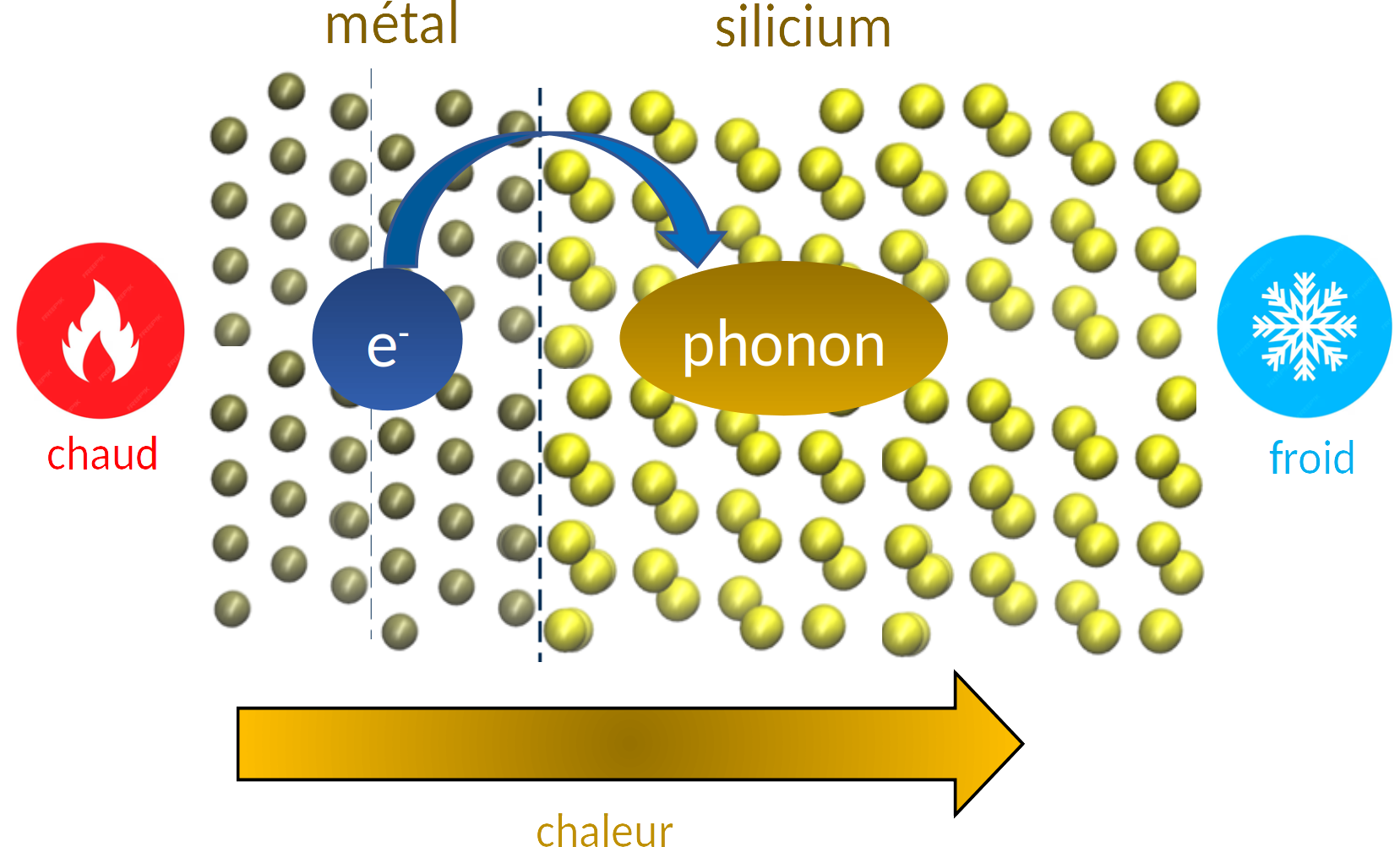
Grâce à des calculs quantiques, ce travail prédit l’existence d’un couplage électron-phonon aux interfaces métal-silicium, qui peut contribuer de manière significative au transfert de chaleur interfacial. Les auteurs montrent en particulier que l’intensité de ce couplage augmente avec la fréquence de Debye du métal, qui est une mesure de son élasticité. Les résultats de cette étude ouvrent la voie au contrôle des transferts de chaleur interfaciaux par l’intermédiaire d’effets électroniques.
Grâce à des calculs quantiques, ce travail prédit l’existence d’un couplage électron-phonon aux interfaces métal-silicium, qui peut contribuer de manière significative au transfert de chaleur interfacial. Les auteurs montrent en particulier que l’intensité de ce couplage augmente avec la fréquence de Debye du métal, qui est une mesure de son élasticité. Les résultats de cette étude ouvrent la voie au contrôle des transferts de chaleur interfaciaux par l’intermédiaire d’effets électroniques.
High-performance computing applications, such as artificial intelligence, generate enormous amounts of heat, making thermal regulation at the nanoscale essential. To understand and optimize heat transfer between silicon chips and metallic heat sinks, it is crucial to understand heat transfer at metal-semiconductor interfaces. Until now, it was assumed that heat transfer was dominated by couplings between the vibrational modes of the materials (phonons) and that metal electrons played a negligible role.
Using quantum calculations, this work the existence of electron-phonon coupling at metal-silicon interfaces, which can contribute significantly to interfacial heat transfer. The authors show, in particular, that the strength of this coupling increases with the Debye frequency of the metal, which is a measure of its elasticity. The results of this study pave the way for controlling interfacial heat transfer through electronic effects.
Using quantum calculations, this work the existence of electron-phonon coupling at metal-silicon interfaces, which can contribute significantly to interfacial heat transfer. The authors show, in particular, that the strength of this coupling increases with the Debye frequency of the metal, which is a measure of its elasticity. The results of this study pave the way for controlling interfacial heat transfer through electronic effects.