

















Mouillage de matériaux poreux par des fluides complexes
Wetting of porous media by complex fluids
Manon Bourgade, Nicolas Bain, Loïc Vanel, Mathieu Leocmach et Catherine Barentin (équipe Liquides & Interfaces), en collaboration des collègues d’Aubervilliers, ont publié un article intitulé "Capillary and priming pressures control the penetration of yield-stress fluids through non-wetting 2D meshes" dans la revue Soft Matter. Cet article a fait l'objet d'une actualité CNRS Physique et a été repris comme fait marquant dans le livret Une année avec CNRS Physique 2025.
Manon Bourgade, Nicolas Bain, Loïc Vanel, Mathieu Leocmach and Catherine Barentin (Liquides & Interfaces team), in collaboration with colleagues from Aubervilliers, published an article entitled "Capillary and priming pressures control the penetration of yield-stress fluids through non-wetting 2D meshes" in the journal Soft Matter. This article was highlighted in the CNRS Physics news and in the booklet Une année avec CNRS Physique 2025.
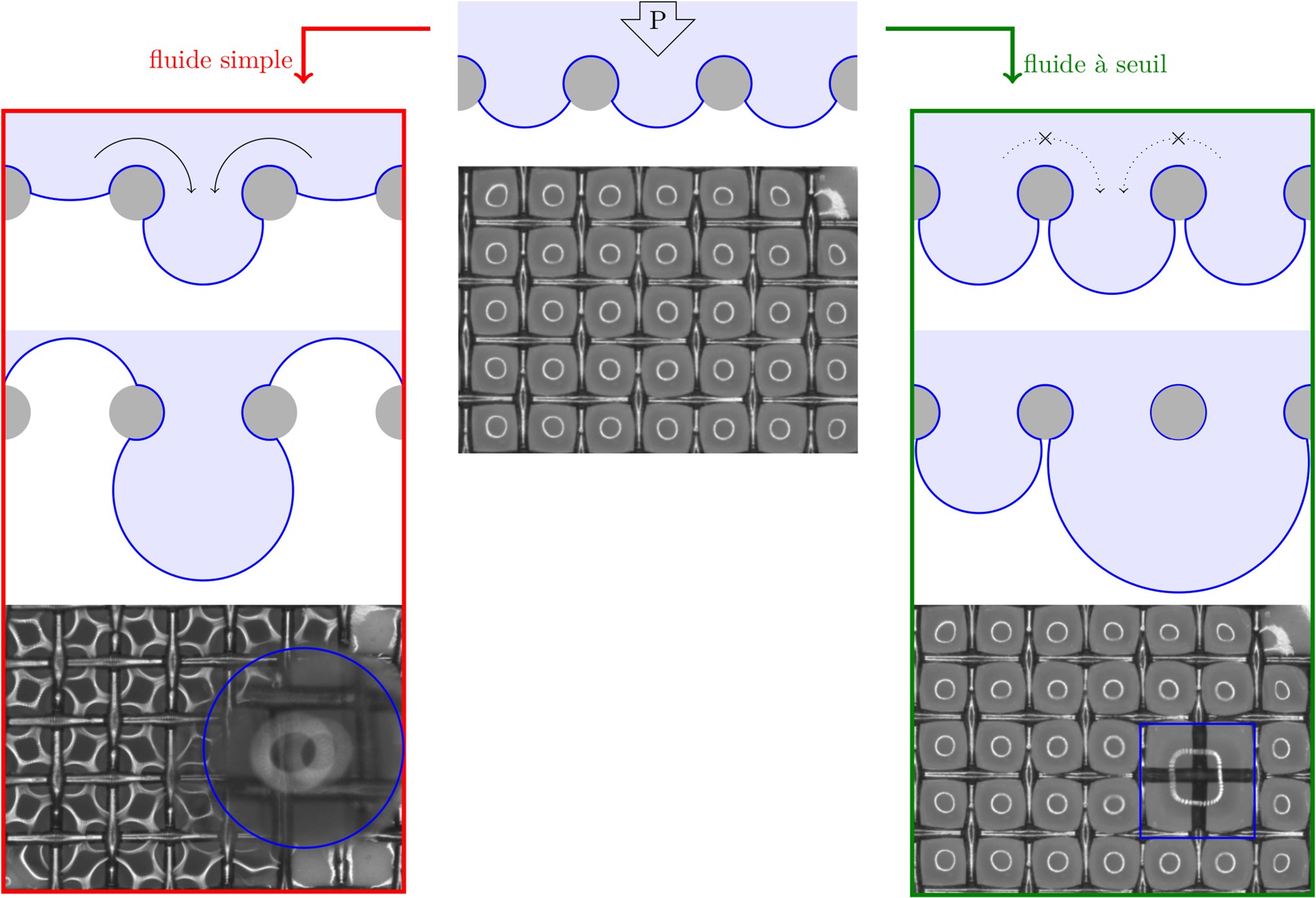
Faire pénétrer un fluide hydrophile à travers un solide poreux hydrophobe constitue un défi industriel. Si le cas des fluides simples est bien connu, celui des fluides complexes reste largement inexplorée. Dans cet article, les auteurs étudient expérimentalement la pénétration forcée d’une pâte (fluide à seuil) à travers un maillage hydrophobe, en combinant mesures de pression et visualisation directe. Ils montrent que la pénétration est contrôlée par la compétition entre les propriétés de la pâte (contrainte seuil) et deux pressions capillaires : la pression de Laplace, qui détermine le seuil à partir duquel le fluide pénètre dans le maillage, et une pression d'amorçage, qui contrôle la manière dont le fluide progresse. Cette dernière correspond à une chute de pression résultant d'une instabilité locale, jamais rapportée auparavant. Enfin, les auteurs montrent qu'une pâte pénètre de manière beaucoup plus homogène à travers un maillage hydrophobe qu'un fluide simple.
Forcing hydrophilic fluids through hydrophobic porous solids is a recurrent industrial challenge. While the penetration of simple fluids is well known, that of complex fluids remains largely unexplored. Here, the authors experimentally investigate the forced penetration of a water based paste (yield-stress fluid) through an hydrophobic mesh, combining pressure measurements and direct visualisation of the penetration process. The authors show that the penetration is controlled by a competition between the mechanical properties of the paste (yield stress) and two distinct capillary pressures: the Laplace pressure, which dictates the threshold at which the fluid penetrates the mesh, and a priming pressure, which controls how the fluid advances through it. The latter corresponds to a pressure drop ensuing a local instability, never reported before. Finally, the authors show that a paste penetrates much more homogeneously through an hydrophobic mesh as a simple liquid.