

















Contrôler la conversion de lumière avec des cristaux photoniques.
Control light conversion with photonic crystals
Damien Rinnert, Gilles Ledoux (équipe Luminescence) et Antonio Pereira (équipe MNP), en collaboration avec des collègues de Lyon, ont publié un article intitulé "Multiwavelength UV upconversion in lanthanides assisted by photonic crystals" dans la revue ACS photonics.
Damien Rinnert, Gilles Ledoux (team Luminescence) and Antonio Pereira (team MNP), with colleagues from Lyon, published an article entitled "Multiwavelength UV upconversion in lanthanides assisted by photonic crystals" in the journal ACS Photonics.
La collecte et le stockage de l’énergie solaire sont aujourd’hui des enjeux sociétaux majeurs pour accompagner les transitions énergétiques de nos sociétés. Des applications de photocatalyses, telles que la production d’hydrogène ou la réduction de CO2 et d’autres polluants, contribuent à la décarbonation de nos énergies et industries.
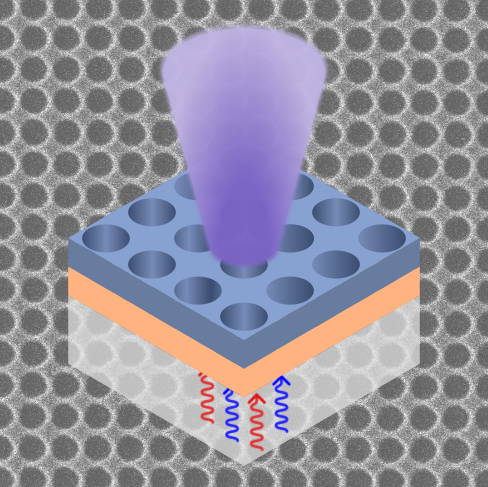
Cependant les photocatalyseurs utilisés pour ces applications sont sensibles dans la gamme spectrale des ultraviolets (UV), ne représentant qu’une très faible partie de l’énergie solaire disponible (∼5%). Les propriétés optiques exceptionnelles des lanthanides permettent la conversion d’une partie du visible et de l’infra-rouge solaire en UV. Leur efficacité est notamment limitée par leur faible absorption. Dans ce travail, nous présentons et démontrons l’efficacité d’un cristal photonique pour augmenter l’interaction lumière-matière dans une couche mince dopée à l’ytterbium et au thulium. Dépourvu d’absorption parasite, il permet de contrôler le processus d’upconversion multi-longueurs d'ondes et ainsi augmenter l’émission UV d’un facteur 28. Les caractéristiques expérimentales du cristal photoniques correspondent aux simulations électromagnétiques effectuées.
Ces résultats ouvrent la voie à l’élaboration de designs plus efficaces, plus avancés, et à de plus grandes échelles, en direction de potentielles applications viables pour des sociétés à plus faibles impacts carbones.
Cependant les photocatalyseurs utilisés pour ces applications sont sensibles dans la gamme spectrale des ultraviolets (UV), ne représentant qu’une très faible partie de l’énergie solaire disponible (∼5%). Les propriétés optiques exceptionnelles des lanthanides permettent la conversion d’une partie du visible et de l’infra-rouge solaire en UV. Leur efficacité est notamment limitée par leur faible absorption. Dans ce travail, nous présentons et démontrons l’efficacité d’un cristal photonique pour augmenter l’interaction lumière-matière dans une couche mince dopée à l’ytterbium et au thulium. Dépourvu d’absorption parasite, il permet de contrôler le processus d’upconversion multi-longueurs d'ondes et ainsi augmenter l’émission UV d’un facteur 28. Les caractéristiques expérimentales du cristal photoniques correspondent aux simulations électromagnétiques effectuées.
Ces résultats ouvrent la voie à l’élaboration de designs plus efficaces, plus avancés, et à de plus grandes échelles, en direction de potentielles applications viables pour des sociétés à plus faibles impacts carbones.
The collection and storage of solar energy are major societal challenges to support the energy transitions of our societies. Photocatalytic applications, such as hydrogen production and the reduction of CO₂ and other pollutants, contribute to the reduction of the carbon footprint of our energy and industries.
However, the photocatalysts used for these applications are sensitive in the ultraviolet (UV) spectral range, which represents only a small fraction of the available solar energy (∼5%). The exceptional optical properties of lanthanides enable the conversion of visible and infrared parts of the solar spectrum into UV light. Their efficiency is notably limited by their low absorption. In this work, we present and demonstrate a photonic crystal design enhancing light-matter interaction within a thin film doped with ytterbium and thulium. Free from parasitic absorption, it allows control over a multi-wavelength upconversion process, thus increasing UV emission by a factor of 28. The experimental characteristics of the photonic crystal show very good agreement with the performed electromagnetic simulations.
These results pave the way for the development of more efficient, advanced, and large-scale designs, moving toward potentially viable applications for societies with lower carbon footprints.
However, the photocatalysts used for these applications are sensitive in the ultraviolet (UV) spectral range, which represents only a small fraction of the available solar energy (∼5%). The exceptional optical properties of lanthanides enable the conversion of visible and infrared parts of the solar spectrum into UV light. Their efficiency is notably limited by their low absorption. In this work, we present and demonstrate a photonic crystal design enhancing light-matter interaction within a thin film doped with ytterbium and thulium. Free from parasitic absorption, it allows control over a multi-wavelength upconversion process, thus increasing UV emission by a factor of 28. The experimental characteristics of the photonic crystal show very good agreement with the performed electromagnetic simulations.
These results pave the way for the development of more efficient, advanced, and large-scale designs, moving toward potentially viable applications for societies with lower carbon footprints.