


Contrôler le mouvement des électrons dans les ions moléculaires
Controlling electron motion in molecular ions
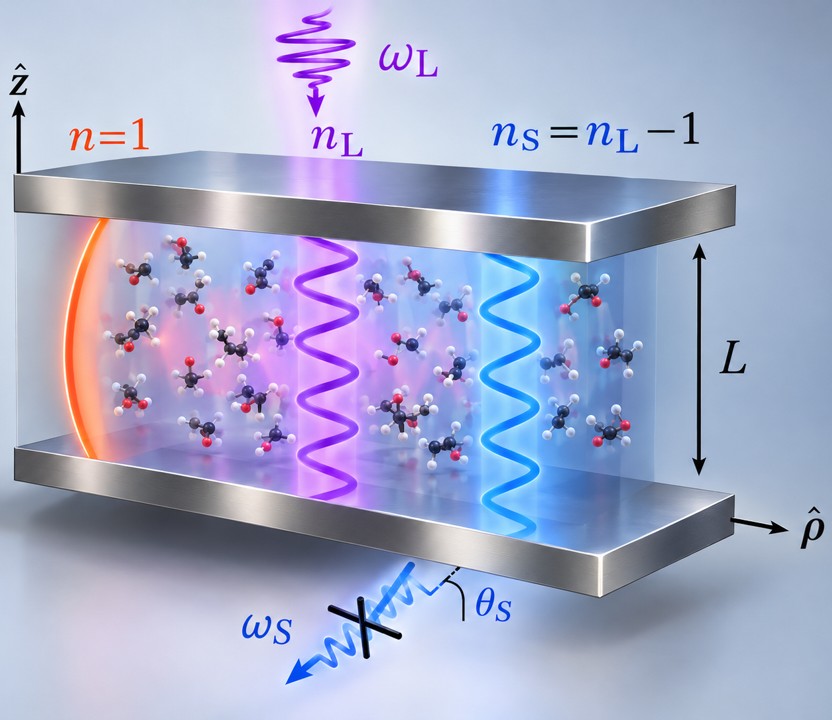
Les électrons peuvent se déplacer dans une molécule en quelques centaines d’attosecondes, bien avant que les noyaux atomiques n’aient le temps de bouger significativement. Ces mouvements électroniques ultrarapides, appelés migrations de charge, peuvent nous aider à comprendre et à contrôler certaines réactions chimiques.
Les auteurs étudient ces migrations dans des molécules protonées et déprotonées, qui portent donc une charge positive ou négative. Ajouter un proton bloque la migration et maintient le « trou » localisé dans la densité électronique, tandis que retirer un proton conserve la dynamique et l’accélère. Ces effets sont liés à la manière dont les électrons se répartissent dans la molécule et à l’influence de la charge sur les corrélations quantiques entre les électrons.
Ces résultats montrent que la charge d’une molécule constitue un levier pour modifier les dynamiques des électrons. Ils ouvrent des perspectives pour observer ces phénomènes dans des systèmes plus complexes, notamment en chimie et en biologie. !--
Controlling electron motion in molecular ions
Evan Munaro-Langloÿs, Franck Lépine and Victor Despré (TheoChem and Dynamo teams), published an article entitled "Tailoring attosecond charge migration in native molecular ions" in the journal Communications Chemistry.Electrons can move inside a molecule within a few hundred attoseconds, long before its atomic nuclei have time to significantly move. This ultrafast motion, known as charge migration, could help us understand and control chemical reactions.
The authors study charge migration in protonated and deprotonated molecules, carrying either a positive or a negative charge. Adding a proton suppresses the migration and keeps the electronic “hole” localized, whereas removing a proton preserves the dynamics and makes it faster. These effects are linked to how electrons redistribute within the molecule and how the charge influences the quantum correlations between the electrons.
The results show that a molecule’s charge can be used to tune electron dynamics. They open perspectives for observing these phenomena in more complex systems, including chemical and biological environments.



Une expérience de laboratoire pour quantifier le pouvoir refroidissant ou réchauffant des aérosols
A laboratory experiment to quantify the cooling or warming potential of atmospheric aerosols
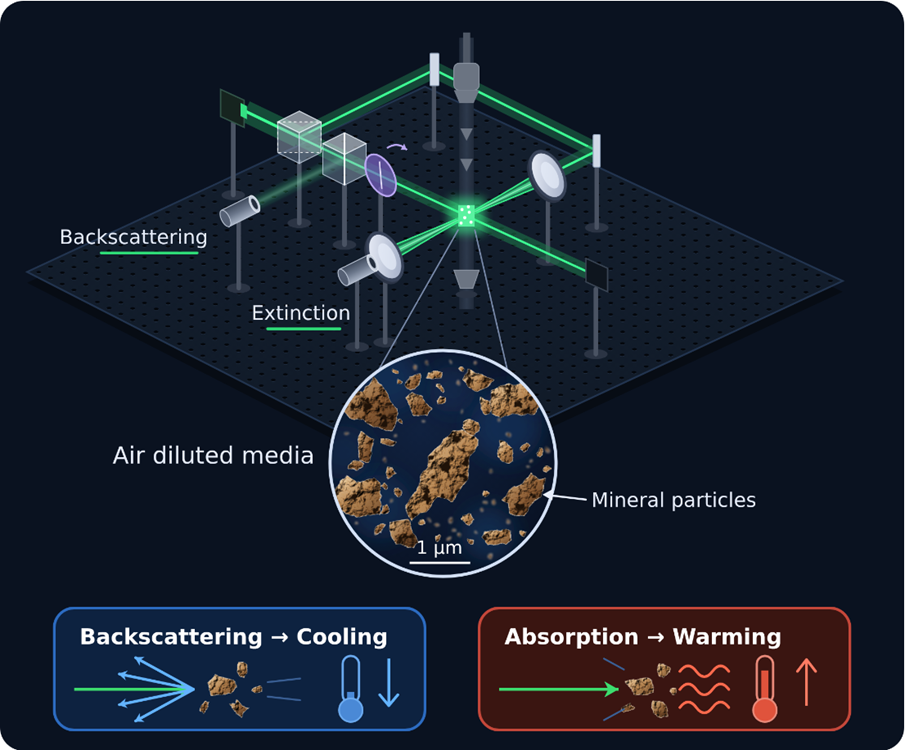
Les particules de notre atmosphère peuvent refroidir ou réchauffer le climat en rétrodiffusant ou en absorbant la lumière. Leur impact reste toutefois difficile à quantifier en raison de la diversité de leur taille, de leur forme et de leur indice optique.
Au laboratoire, nous avons développé une expérience unique au monde permettant de mesurer simultanément la rétrodiffusion et l’extinction de la lumière par des particules en suspension dans l’air. Grâce à la technique de cavity ring-down, l’extinction a pu mesurée avec une grande sensibilité malgré la très faible intensité de la lumière rétrodiffusée. Le rapport extinction/rétrodiffusion a ainsi pu être mesuré pour la première fois en laboratoire. Il vaut (47± 2) sr pour des particules minérales.
Cette méthodologie, qui ne nécessite aucune connaissance préalable de la taille, de la forme ou de l’indice optique des particules, permet, de par sa précision, d’améliorer l’évaluation des modèles de diffusion de la lumière et l’interprétation des observations lidar et satellitaires du climat.
A laboratory experiment to quantify the cooling or warming potential of atmospheric aerosols
Alain Miffre, Clément Pacoret-Berenger, Adrien Genoud et Patrick Rairoux (team ATMOS), have published an article entitled "A novel laboratory methodology to evaluate the particle extinction-to-backscatter ratio or particle lidar ratio of aerosols" in the journal Scientific Reports.Atmospheric particles can cool or warm the Earth’s climate by backscattering or absorbing light. Quantifying their impact remains challenging because of the diversity in their size, shape, and optical properties.
In the laboratory, we have developed a unique experimental setup that enables the simultaneous measurement of light backscattering and extinction by airborne particles. Using the cavity ring-down technique, extinction could be measured with high sensitivity despite the very low intensity of the backscattered light. The extinction-to-backscattering ratio could thus be measured for the first time in the laboratory. It is (47± 2) sr for mineral particles.
Thanks to its precision, this methodology, which requires no prior knowledge of particle size, shape, or refractive index, enables improved evaluation of light-scattering models and more robust interpretation of lidar and satellite observations of the climate.


Les Agrégats atomiques : Thermodynamique, propriétés optiques et atomiques
Atomic Clusters: Thermodynamics, Optical and Atomic Properties
Dans cet ouvrage qui constitue le deuxième tome des Agrégats Atomiques, les auteurs s’intéressent aux excitations des agrégats, qu’elles soient thermiques, optiques ou autres. Tout d’abord, ils décrivent leurs propriétés thermodynamiques. En raison du petit nombre d’atomes, les fluctuations sont très importantes et en particulier influencent de façon notable la température de fusion, ce qui est mesurable. De plus, il est possible d’observer la fragmentation des agrégats par collision avec des électrons ou des photons et de revisiter à l’échelle nanométrique le critère de Rayleigh pour l’explosion coulombienne. Leur ionisation en fonction de leur taille est également étudiée.
Enfin les propriétés optiques des petits agrégats sont décrites, avec l’émergence de la résonance géante dite « résonance de plasmon de surface » qui n’existe ni dans l’atome, ni en matière condensée. Les conditions pour que ce phénomène apparaisse, sont discutées, ainsi que ses principales caractéristiques. Cette résonance géante confère aux agrégats des propriétés optiques particulièrement intéressantes du point de vue fondamental et pour de nombreuses applications.
Atomic Clusters: Thermodynamics, Optical and Atomic Properties
Michel Broyer (team Clusters and Nanostructures) and Patrice Mélinon (team Transport, Nanomagnetism and Energy Materials) have each contributed to the book entitled "Atomic Clusters", published in September 2026 by EDP Sciences and CNRS Éditions, as part of the Savoirs Actuels collection.In this volume, which constitutes the second part of Atomic Clusters, the authors explore the excitations of clusters, whether thermal, optical, or of other kinds. They first describe their thermodynamic properties. Because of the small number of atoms involved, fluctuations are very significant and, in particular, have a substantial influence on the melting temperature, which can be measured experimentally. In addition, cluster fragmentation can be observed through collisions with electrons or photons, making it possible to revisit, at the nanoscale, the Rayleigh criterion for Coulomb explosion. The ionization of clusters as a function of their size is also investigated.
Finally, the optical properties of small clusters are described, with the emergence of the so-called giant resonance known as the “surface plasmon resonance”, which exists neither in atoms nor in condensed matter. The conditions required for this phenomenon to occur are discussed, as well as its main characteristics. This giant resonance gives clusters particularly interesting optical properties, both from a fundamental perspective and for numerous applications.