


Quand les ions ralentissent l'eau au contact du verre
When ions slow down water at the surface of glass
Aymeric Allemand, Anne-Laure Biance, Christophe Ybert et Laurent Joly (équipes Liquides et interfaces et MMCI) ont publié un article intitulé "Molecular insight on ultra-confined ionic transport in wetting films: The key role of friction" dans la revue The Journal of Chemical Physics.
Aymeric Allemand, Anne-Laure Biance, Christophe Ybert and Laurent Joly (Liquids and interfaces and MMCI teams) published an article entitled "Molecular insight on ultra-confined ionic transport in wetting films: The key role of friction" in The Journal of Chemical Physics.
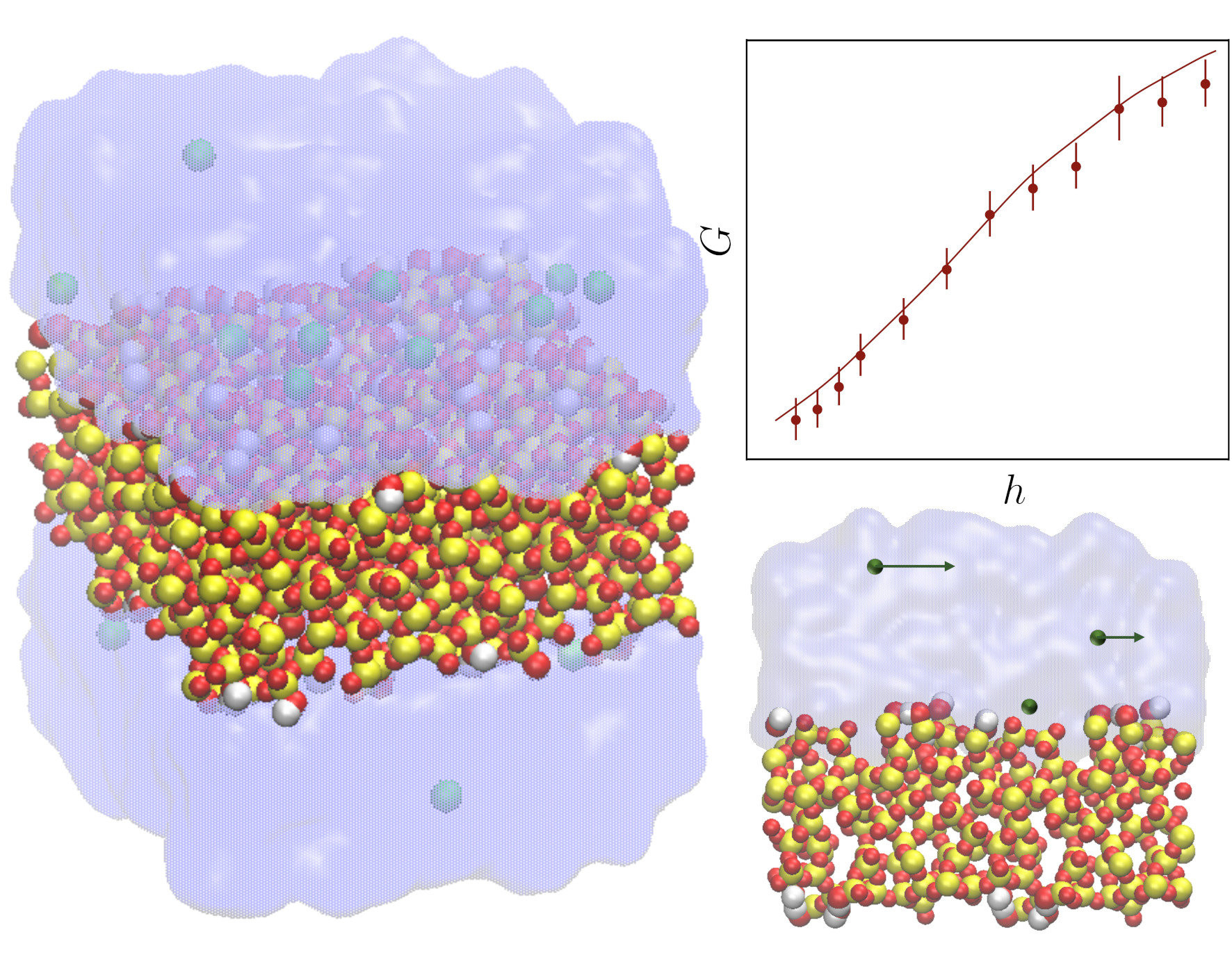
L’équipe a étudié comment l'eau se comporte lorsqu'elle forme un film ultra-fin sur une surface de verre – à peine quelques molécules d'épaisseur ! Ils ont découvert que certains ions, comme le potassium, ont tendance à « coller » à la surface, créant une friction supplémentaire qui ralentit considérablement l'eau. Cela modifie aussi sa capacité à conduire l'électricité. Cette découverte aide à mieux comprendre les systèmes nanofluidiques utilisés pour la filtration de l'eau, la production d'énergie ou même le calcul inspiré du cerveau. À cette échelle minuscule, l'eau ne se comporte plus comme on l'attendrait !
The team studied how water behaves when it forms an ultra-thin film on a glass surface—just a few molecules thick! They discovered that certain ions (like potassium) tend to "stick" to the surface, creating additional friction that significantly slows down the water. This also changes its ability to conduct electricity. This discovery helps us better understand nanofluidic systems used for water filtration, energy production, or even brain-inspired computing. At this tiny scale, water no longer behaves as we would expect!