


De la possibilité des tas de sable
On the possibility of sand heaps
Jesús Fernández, Loïc Vanel et Antoine Bérut (équipe Liquides et Interfaces) ont publié un article intitulé "Colloidal suspensions can have nonzero angles of repose below the minimal value for athermal frictionless particles" dans la revue Physical Review Letters. Cet article a été sélectionné comme suggestion de lecture par l'éditeur.
Jesús Fernández, Loïc Vanel and Antoine Bérut (Liquids and Interfaces team) published an article entitled "Colloidal Suspensions can have Nonzero Angles of Repose Below the Minimal Value for Athermal Frictionless Particles" in the journal Physical Review Letters. This article was selected at “Editor’s suggestion”.
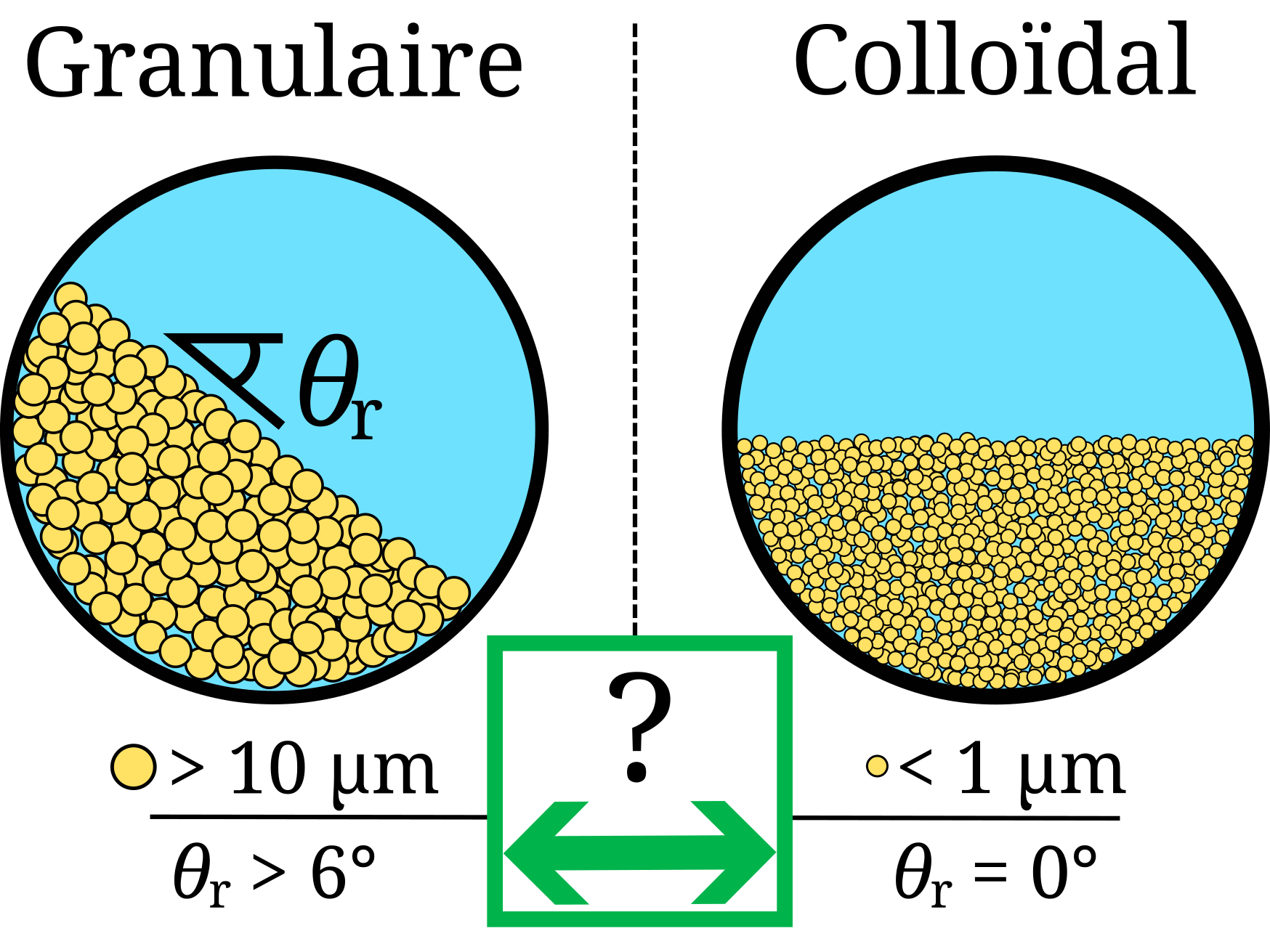
Une spécificité des milieux granulaires est leur capacité à former un tas stable, c’est-à-dire qu’à l’inverse d’un liquide, les grains peuvent rester sur une surface inclinée sans s’écouler. Cependant, lorsque les grains deviennent suffisamment petits, l’agitation thermique entre en jeu, et cette propriété peut alors disparaître.
Les auteurs ont développé une approche microfluidique pour mesurer l’angle auquel des suspensions de particules de silice de quelques micromètres cessent de s’écouler après inclinaison. Ils ont ainsi pu étudier la transition entre un régime « granulaire » et un régime « colloïdal » où un tas ne peut jamais se former, en fonction du rapport entre le poids des grains et l’agitation thermique. Plus d’information dans le communiqué Lyon 1.
Les auteurs ont développé une approche microfluidique pour mesurer l’angle auquel des suspensions de particules de silice de quelques micromètres cessent de s’écouler après inclinaison. Ils ont ainsi pu étudier la transition entre un régime « granulaire » et un régime « colloïdal » où un tas ne peut jamais se former, en fonction du rapport entre le poids des grains et l’agitation thermique. Plus d’information dans le communiqué Lyon 1.
A distinctive feature of granular media is their ability to form a stable pile, which means that, unlike a liquid, the grains can remain on a inclined surface without flowing. However, when the grains become sufficiently small, thermal agitation comes into play, and this property may disappear.
The authors have developed a microfluidic approach to measure the angle at which suspensions of micrometer-sized silica particles stop flowing after being tilted. They have studied the transition between a "granular" regime and a "colloidal" regime, where a pile cannot form, that occurs when the ratio between the weight of the grains and the thermal agitation increases.
The authors have developed a microfluidic approach to measure the angle at which suspensions of micrometer-sized silica particles stop flowing after being tilted. They have studied the transition between a "granular" regime and a "colloidal" regime, where a pile cannot form, that occurs when the ratio between the weight of the grains and the thermal agitation increases.