


Quand le couplage avec la lumière éteint le signal Raman
When coupling to light switches off the Raman signal
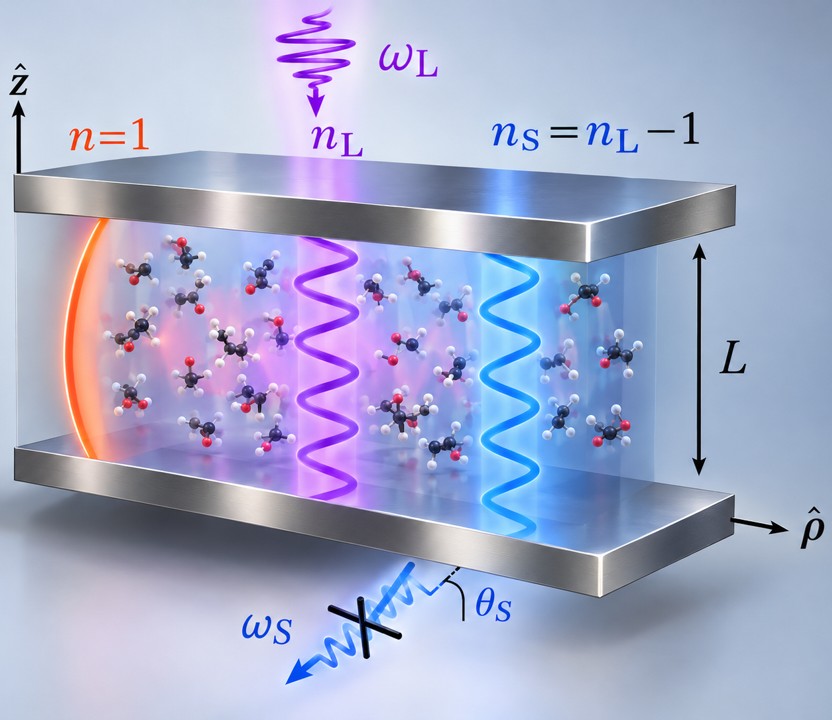
Lorsque la lumière interagit fortement avec les vibrations des molécules, elle peut former de nouveaux états hybrides, appelés polaritons. Ces états « vibration/lumière », obtenus notamment en plaçant des molécules dans des cavités optiques, permettent de contrôler certaines propriétés moléculaires et ouvrent de nouvelles voies pour la chimie. Les signatures Raman de ces polaritons ont toutefois donné lieu à des résultats expérimentaux controversés, en particulier pour les molécules organiques. Dans cette étude théorique, les auteurs montrent que la géométrie de la cavité et la répartition spatiale des molécules sont déterminantes. Ils mettent en évidence une règle de sélection qui interdit le signal Raman des polaritons dans la géométrie habituellement utilisée en expérience, en raison de la cohérence collective des vibrations moléculaires. Les auteurs proposent également une stratégie pour rendre ce signal observable, notamment à l’aide de matériaux bidimensionnels (2D). Ces résultats permettent de mieux comprendre des observations expérimentales jusque-là contradictoires et ouvrent de nouvelles perspectives pour l’étude et le contrôle de la matière en régime de couplage fort.
When coupling to light switches off the Raman signal
Joel Bellessa and Clémentine Symonds (MNP team), in collaboration with colleagues from Strasbourg, have published a paper entitled "Spontaneous Raman scattering under vibrational strong coupling: the critical role of polariton spatial mode coherence" in Physical Review Letters.When light strongly interacts with molecular vibrations, it can form new hybrid states known as polaritons. These “vibration/light” states, obtained in particular by placing molecules inside optical cavities, make it possible to control certain molecular properties and open up new avenues for chemistry. However, Raman signatures of these polaritons have led to controversial experimental results, particularly for organic molecules.
In this theoretical study, the authors show that the cavity geometry and the spatial distribution of the molecules play a crucial role. They identify a selection rule that prevents the Raman signal of polaritons from appearing in the geometry commonly used in experiments, due to the collective coherence of the molecular vibrations. The authors also propose a strategy to make this signal observable, notably by using two-dimensional (2D) materials. These results provide a better understanding of previously conflicting experimental observations and open up new perspectives for studying and controlling matter in the strong-coupling regime.