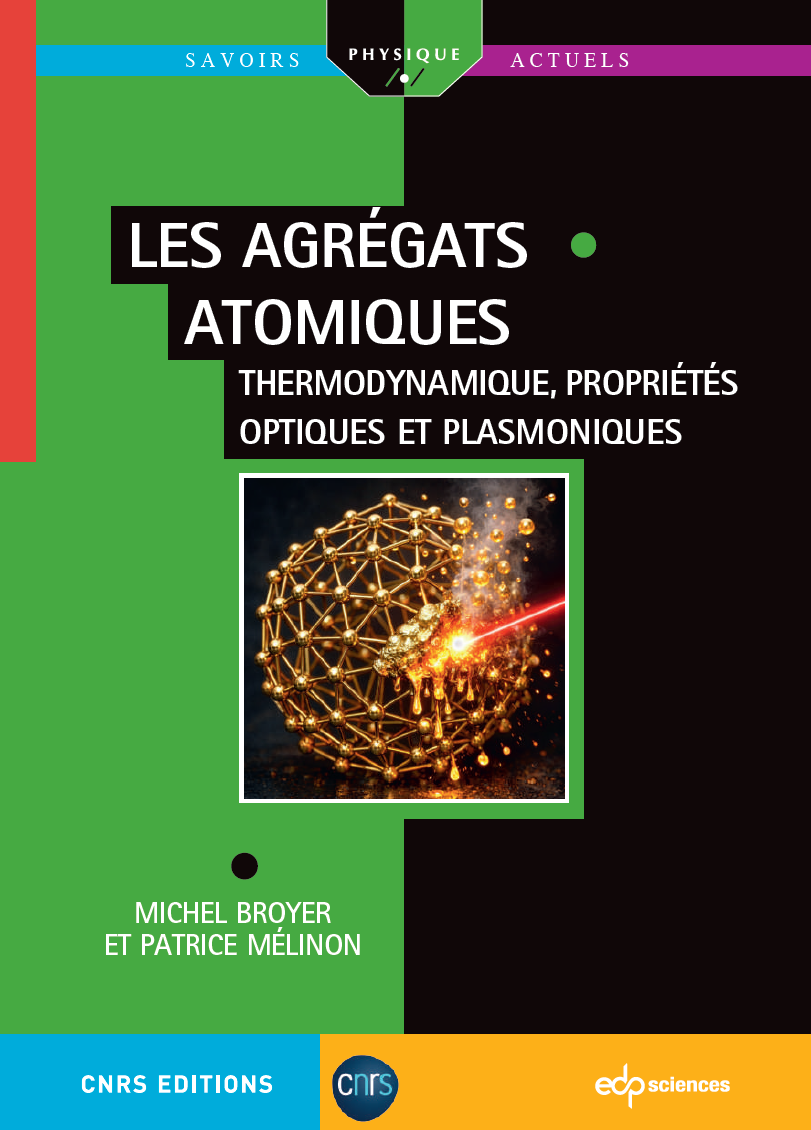



Les Agrégats atomiques : Thermodynamique, propriétés optiques et atomiques
Atomic Clusters: Thermodynamics, Optical and Atomic Properties
Dans cet ouvrage qui constitue le deuxième tome des Agrégats Atomiques, les auteurs s’intéressent aux excitations des agrégats, qu’elles soient thermiques, optiques ou autres. Tout d’abord, ils décrivent leurs propriétés thermodynamiques. En raison du petit nombre d’atomes, les fluctuations sont très importantes et en particulier influencent de façon notable la température de fusion, ce qui est mesurable. De plus, il est possible d’observer la fragmentation des agrégats par collision avec des électrons ou des photons et de revisiter à l’échelle nanométrique le critère de Rayleigh pour l’explosion coulombienne. Leur ionisation en fonction de leur taille est également étudiée.
Enfin les propriétés optiques des petits agrégats sont décrites, avec l’émergence de la résonance géante dite « résonance de plasmon de surface » qui n’existe ni dans l’atome, ni en matière condensée. Les conditions pour que ce phénomène apparaisse, sont discutées, ainsi que ses principales caractéristiques. Cette résonance géante confère aux agrégats des propriétés optiques particulièrement intéressantes du point de vue fondamental et pour de nombreuses applications.
Atomic Clusters: Thermodynamics, Optical and Atomic Properties
Michel Broyer (team Clusters and Nanostructures) and Patrice Mélinon (team Transport, Nanomagnetism and Energy Materials) have each contributed to the book entitled "Atomic Clusters", published in September 2026 by EDP Sciences and CNRS Éditions, as part of the Savoirs Actuels collection.In this volume, which constitutes the second part of Atomic Clusters, the authors explore the excitations of clusters, whether thermal, optical, or of other kinds. They first describe their thermodynamic properties. Because of the small number of atoms involved, fluctuations are very significant and, in particular, have a substantial influence on the melting temperature, which can be measured experimentally. In addition, cluster fragmentation can be observed through collisions with electrons or photons, making it possible to revisit, at the nanoscale, the Rayleigh criterion for Coulomb explosion. The ionization of clusters as a function of their size is also investigated.
Finally, the optical properties of small clusters are described, with the emergence of the so-called giant resonance known as the “surface plasmon resonance”, which exists neither in atoms nor in condensed matter. The conditions required for this phenomenon to occur are discussed, as well as its main characteristics. This giant resonance gives clusters particularly interesting optical properties, both from a fundamental perspective and for numerous applications.