



Plasmon dans le continuum
Plasmon in the Continuum
Les plasmons sont connus pour leurs applications potentielles dans l’imagerie haute résolution, la détection, la photocatalyse et les technologies optiques à l’échelle nanométrique. L’intérêt croissant pour l’extension des applications plasmoniques au domaine de l’ultraviolet (UV) a stimulé la recherche sur les agrégats constitués de matériaux plasmoniques non conventionnels, tels que l’aluminium et l’indium.
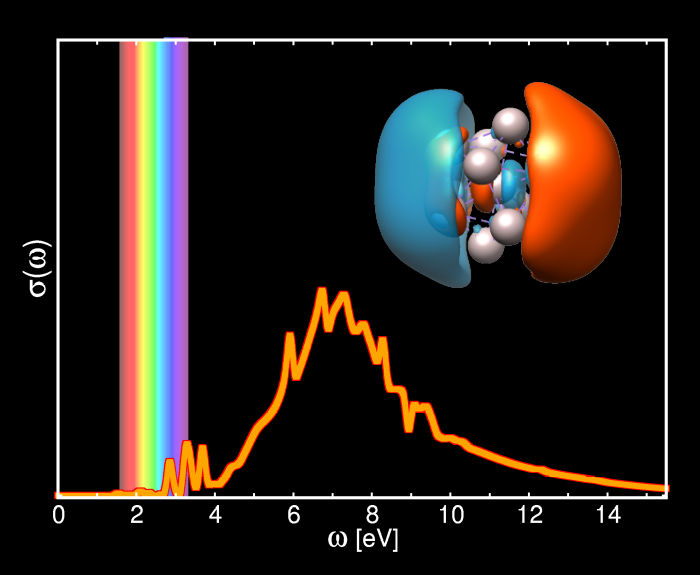
Les auteurs ont étudié la réponse collective des électrons dans des agrégats d’aluminium, mettant en évidence de larges résonances de plasmons de surface dans l’UV. Ils ont démontré qu’il est essentiel de prendre correctement en compte l’ionisation pour décrire avec précision ces résonances. Ces résultats permettent d’améliorer notre compréhension des agrégats métalliques en vue de futures applications plasmoniques dans l’UV.
Plasmon in the Continuum
Franck Rabilloud, Victor Despré, Jean Lermé, and Rajarshi Sinha-Roy (Theoretical Physical chemistry and Clusters and nanostructures teams), with colleagues from Marseille and Trieste, published an article entitled "Surface Plasmons in the Continuum" in The Journal of Physical Chemistry Letters.Plasmons are known for potential applications in high-resolution imaging, sensing, photocatalysis, and nanoscale optical technologies. The growing interest in extending plasmonic applications to the ultraviolet (UV) range has stimulated research on clusters made of unconventional plasmonic materials, such as aluminum and indium.
The authors investigated the collective response of electrons in aluminum clusters, revealing broad surface plasmon resonances in the UV. They demonstrated that properly accounting for ionization is essential to accurately describe these resonances. These findings allow to improve our understanding of metal clusters for future UV plasmonic applications.
JPCL