


L’IA dévoile des nouveaux biomarqueurs minéraux des maladies neurologiques
AI reveals new mineral biomarkers for neurological disorders
Augustin Tillement, François Lux et Olivier Tillement (équipe FENNEC), en collaboration avec des collègues de Lyon, Strasbourg et Hombourg ont publié un article intitulé "Artificial intelligence decodes brain elemental signatures to stratify aging and neurological diseases" dans la revue Research.
Augustin Tillement, François Lux and Olivier Tillement (FENNEC team), with colleagues from Lyon, Strasbourg and Homburg published an article entitled "Artificial intelligence decodes brain elemental signatures to stratify aging and neurological diseases" in the journal Research.
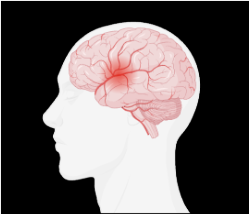
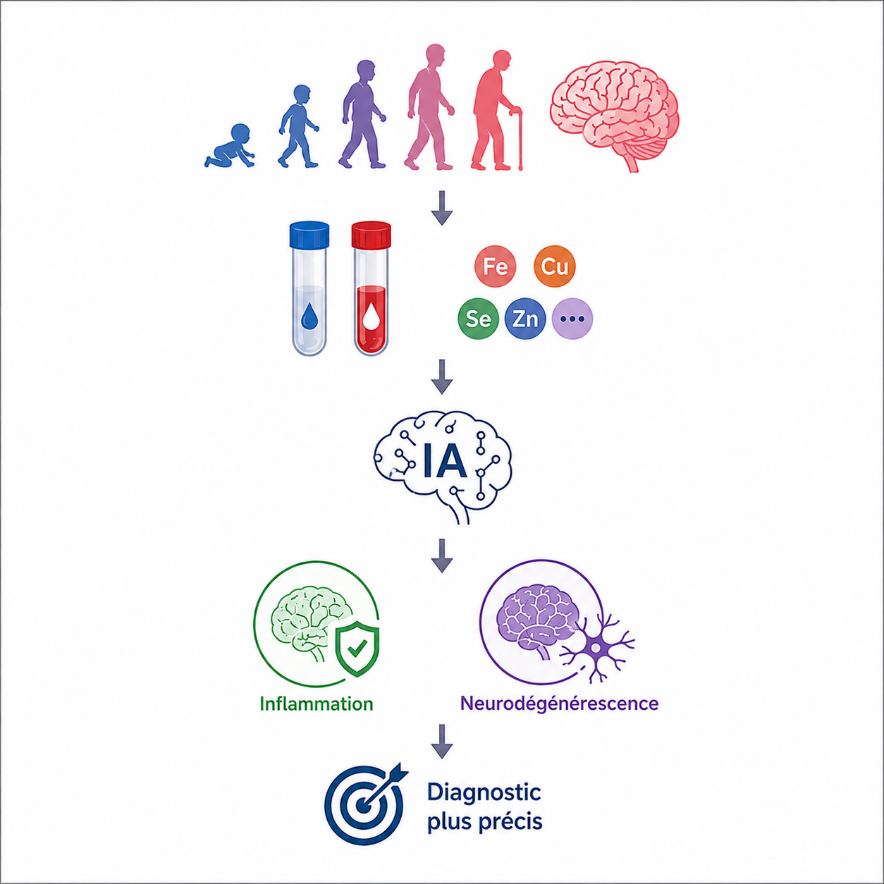
Avec l'âge, la composition en éléments minéraux du cerveau évolue progressivement, mais ces changements restent encore peu étudiés dans les maladies neurologiques. En analysant le liquide céphalorachidien et le sang de plus de 1600 personnes, il a été montré que le vieillissement s'accompagne de signatures minérales spécifiques reflétant notamment des modifications de la barrière qui protège le cerveau. Grâce à l'intelligence artificielle, des profils différents selon les maladies ont été identifiés, distinguant notamment les affections inflammatoires des maladies neurodégénératives. L'étude montre également que ces signatures évoluent différemment au cours de la vie selon les mécanismes pathologiques en jeu. En combinant ces informations avec les données cliniques conventionnelles, il est possible d'améliorer la précision du diagnostic. Ces travaux ouvrent la voie à de nouveaux biomarqueurs et à une médecine plus personnalisée pour les maladies neurologiques liées au vieillissement.
As the brain ages, its mineral composition gradually changes, yet these alterations remain poorly explored in the context of neurological diseases. By analyzing cerebrospinal fluid and blood samples from more than 1,600 individuals, researchers showed that aging is associated with specific elemental signatures, reflecting in particular changes in the blood–brain barrier, which protects the brain. Using artificial intelligence, distinct profiles were identified across different neurological conditions, notably distinguishing inflammatory disorders from neurodegenerative diseases. The study also revealed that these signatures evolve differently throughout life depending on the underlying pathological mechanisms. Combining elemental signatures with conventional clinical data improves diagnostic accuracy. These findings pave the way for the development of new biomarkers and more personalized approaches to the diagnosis and management of age-related neurological disorders.

Comment s’atténuent les vibrations des nanoparticules?
How do nanoparticle vibrations decay?
Nathan Berrit, Noëlle Lascoux, Clément Panais, Natalia Del Fatti et Aurélien Crut (équipe FemtoNanoOptics), en collaboration avec une collègue de Saclay, ont publié un article intitulé "Vibrational damping of single supported plasmonic nanodisks" dans la revue The Journal of Physical Chemistry Letters.
Nathan Berrit, Noëlle Lascoux, Clément Panais, Natalia Del Fatti and Aurélien Crut (FemtoNanoOptics team), with a colleague from Saclay, published an article entitled "Vibrational damping of single supported plasmonic nanodisks" in the journal The Journal of Physical Chemistry Letters.
Les résonateurs mécaniques jouent un rôle central dans des domaines variés tels que la détection, la métrologie et les télécommunications. Parmi eux, les nanoparticules métalliques se distinguent par plusieurs atouts notables : des fréquences de résonance extrêmement élevées, la possibilité d’exciter et de détecter optiquement leurs vibrations, ainsi qu’une synthèse aujourd’hui bien maîtrisée. Cependant, leurs performances restent souvent limitées par des facteurs de qualité mécanique relativement faibles, en raison du couplage avec le milieu environnant et de mécanismes d’amortissement intrinsèques.
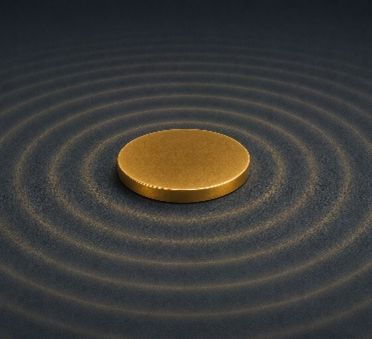
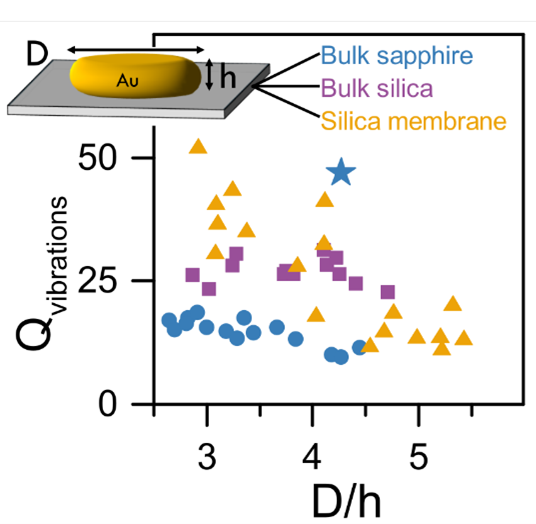
Dans ce contexte, les chercheurs de l’iLM ont étudié, en combinant techniques optiques et simulations numériques, l’amortissement vibrationnel de nanodisques d’or individuels déposés sur des substrats solides. Leur travail a permis de mieux comprendre l’influence de la géométrie des nanorésonateurs ainsi que des propriétés des substrats (composition et épaisseur). Ils ont également montré que certains modes faiblement excités peuvent présenter des facteurs de qualité significativement plus élevés que celui du mode dominant les signaux mesurés.
Dans ce contexte, les chercheurs de l’iLM ont étudié, en combinant techniques optiques et simulations numériques, l’amortissement vibrationnel de nanodisques d’or individuels déposés sur des substrats solides. Leur travail a permis de mieux comprendre l’influence de la géométrie des nanorésonateurs ainsi que des propriétés des substrats (composition et épaisseur). Ils ont également montré que certains modes faiblement excités peuvent présenter des facteurs de qualité significativement plus élevés que celui du mode dominant les signaux mesurés.
Mechanical resonators play a central role in a wide range of fields, including sensing, metrology, and telecommunications. Among them, metal nanoparticles stand out due to several notable advantages: extremely high resonance frequencies, the possibility of optically exciting and detecting their vibrations, and now well-established synthesis procedures. However, their performance is often limited by relatively low mechanical quality factors, due to coupling with the surrounding environment and intrinsic damping mechanisms.
In this context, researchers at the ILM have investigated the vibrational damping of individual gold nanodisks deposited on solid substrates, combining optical techniques with numerical simulations. Their work has provided a better understanding of the influence of both nanoresonator geometry and substrate properties (composition and thickness). They also showed that weakly excited modes can exhibit quality factors significantly higher than that of the mode dominating the measured signals.
In this context, researchers at the ILM have investigated the vibrational damping of individual gold nanodisks deposited on solid substrates, combining optical techniques with numerical simulations. Their work has provided a better understanding of the influence of both nanoresonator geometry and substrate properties (composition and thickness). They also showed that weakly excited modes can exhibit quality factors significantly higher than that of the mode dominating the measured signals.
JPCL

Contrôler la conversion de lumière avec des cristaux photoniques.
Control light conversion with photonic crystals
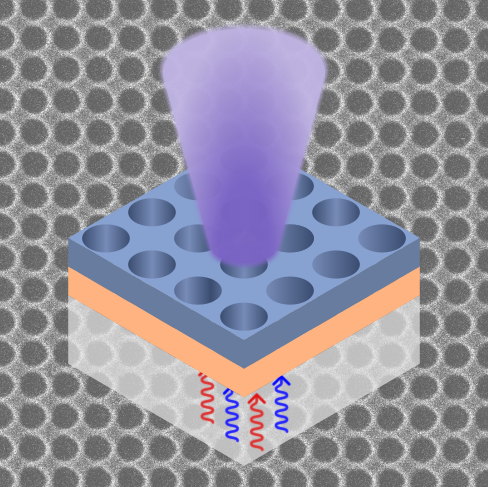
Damien Rinnert, Gilles Ledoux (équipe Luminescence) et Antonio Pereira (équipe MNP), en collaboration avec des collègues de Lyon, ont publié un article intitulé "Multiwavelength UV upconversion in lanthanides assisted by photonic crystals" dans la revue ACS photonics.
Damien Rinnert, Gilles Ledoux (team Luminescence) and Antonio Pereira (team MNP), with colleagues from Lyon, published an article entitled "Multiwavelength UV upconversion in lanthanides assisted by photonic crystals" in the journal ACS Photonics.
La collecte et le stockage de l’énergie solaire sont aujourd’hui des enjeux sociétaux majeurs pour accompagner les transitions énergétiques de nos sociétés. Des applications de photocatalyses, telles que la production d’hydrogène ou la réduction de CO2 et d’autres polluants, contribuent à la décarbonation de nos énergies et industries.
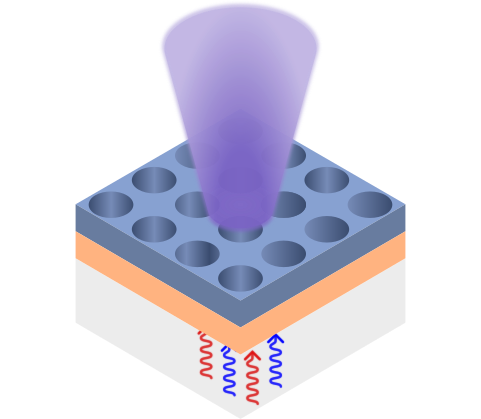
Cependant les photocatalyseurs utilisés pour ces applications sont sensibles dans la gamme spectrale des ultraviolets (UV), ne représentant qu’une très faible partie de l’énergie solaire disponible (∼5%). Les propriétés optiques exceptionnelles des lanthanides permettent la conversion d’une partie du visible et de l’infra-rouge solaire en UV. Leur efficacité est notamment limitée par leur faible absorption. Dans ce travail, nous présentons et démontrons l’efficacité d’un cristal photonique pour augmenter l’interaction lumière-matière dans une couche mince dopée à l’ytterbium et au thulium. Dépourvu d’absorption parasite, il permet de contrôler le processus d’upconversion multi-longueurs d'ondes et ainsi augmenter l’émission UV d’un facteur 28. Les caractéristiques expérimentales du cristal photoniques correspondent aux simulations électromagnétiques effectuées.
Ces résultats ouvrent la voie à l’élaboration de designs plus efficaces, plus avancés, et à de plus grandes échelles, en direction de potentielles applications viables pour des sociétés à plus faibles impacts carbones.
The collection and storage of solar energy are major societal challenges to support the energy transitions of our societies. Photocatalytic applications, such as hydrogen production and the reduction of CO₂ and other pollutants, contribute to the reduction of the carbon footprint of our energy and industries.
However, the photocatalysts used for these applications are sensitive in the ultraviolet (UV) spectral range, which represents only a small fraction of the available solar energy (∼5%). The exceptional optical properties of lanthanides enable the conversion of visible and infrared parts of the solar spectrum into UV light. Their efficiency is notably limited by their low absorption. In this work, we present and demonstrate a photonic crystal design enhancing light-matter interaction within a thin film doped with ytterbium and thulium. Free from parasitic absorption, it allows control over a multi-wavelength upconversion process, thus increasing UV emission by a factor of 28. The experimental characteristics of the photonic crystal show very good agreement with the performed electromagnetic simulations.
These results pave the way for the development of more efficient, advanced, and large-scale designs, moving toward potentially viable applications for societies with lower carbon footprints.