


Quand les ions ralentissent l'eau au contact du verre
When ions slow down water at the surface of glass
Aymeric Allemand, Anne-Laure Biance, Christophe Ybert et Laurent Joly (équipes Liquides et interfaces et MMCI) ont publié un article intitulé "Molecular insight on ultra-confined ionic transport in wetting films: The key role of friction" dans la revue The Journal of Chemical Physics.
Aymeric Allemand, Anne-Laure Biance, Christophe Ybert and Laurent Joly (Liquids and interfaces and MMCI teams) published an article entitled "Molecular insight on ultra-confined ionic transport in wetting films: The key role of friction" in The Journal of Chemical Physics.
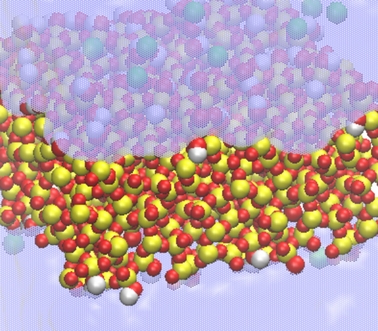
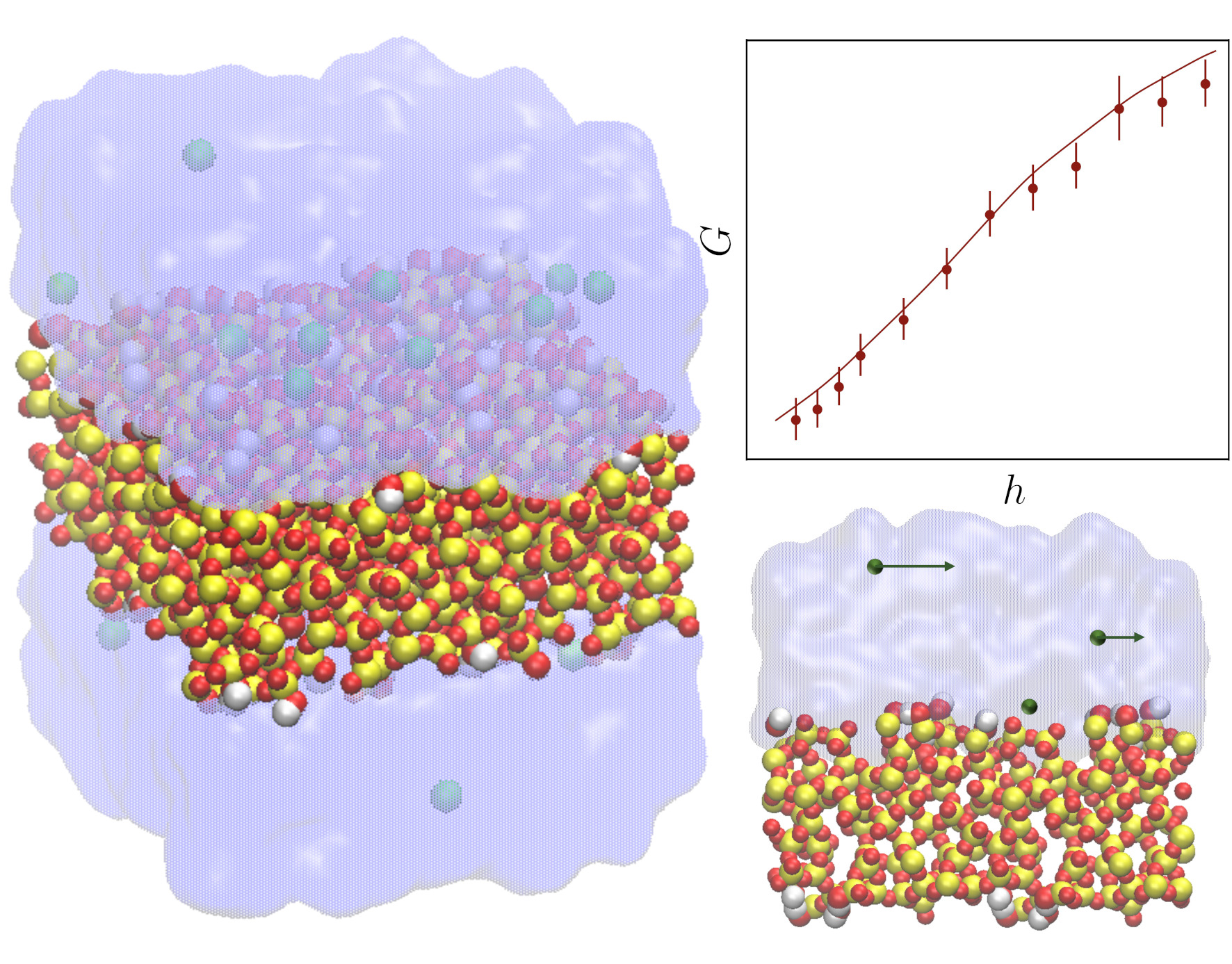
L’équipe a étudié comment l'eau se comporte lorsqu'elle forme un film ultra-fin sur une surface de verre – à peine quelques molécules d'épaisseur ! Ils ont découvert que certains ions, comme le potassium, ont tendance à « coller » à la surface, créant une friction supplémentaire qui ralentit considérablement l'eau. Cela modifie aussi sa capacité à conduire l'électricité. Cette découverte aide à mieux comprendre les systèmes nanofluidiques utilisés pour la filtration de l'eau, la production d'énergie ou même le calcul inspiré du cerveau. À cette échelle minuscule, l'eau ne se comporte plus comme on l'attendrait !
The team studied how water behaves when it forms an ultra-thin film on a glass surface—just a few molecules thick! They discovered that certain ions (like potassium) tend to "stick" to the surface, creating additional friction that significantly slows down the water. This also changes its ability to conduct electricity. This discovery helps us better understand nanofluidic systems used for water filtration, energy production, or even brain-inspired computing. At this tiny scale, water no longer behaves as we would expect!


Densification des électrolytes, enjeu clé pour les batteries solides
Electrolyte densification: a key challenge for solid-state batteries
Sylvie Le Floch, Vittoria Pischedda et Clément Albin (équipe Energie), en collaboration avec des collègues de Grenoble et du synchrotron Soleil, ont publié un article intitulé "High pressure densification investigation of Li3PS4 and Li6PS5Cl solid electrolytes using combine X-ray diffraction, X-ray absorption, tomography and ionic measurement" dans la revue Advanced Functional Materials.
Sylvie Le Floch, Vittoria Pischedda and Clément Albin (team Energie), with colleagues from Grenoble and the synchrotron Soleil, published an article entitled "High pressure densification investigation of Li3PS4 and Li6PS5Cl solid electrolytes using combine X-ray diffraction, X-ray absorption, tomography and ionic measurement" in the journal Advanced Functional Materials.
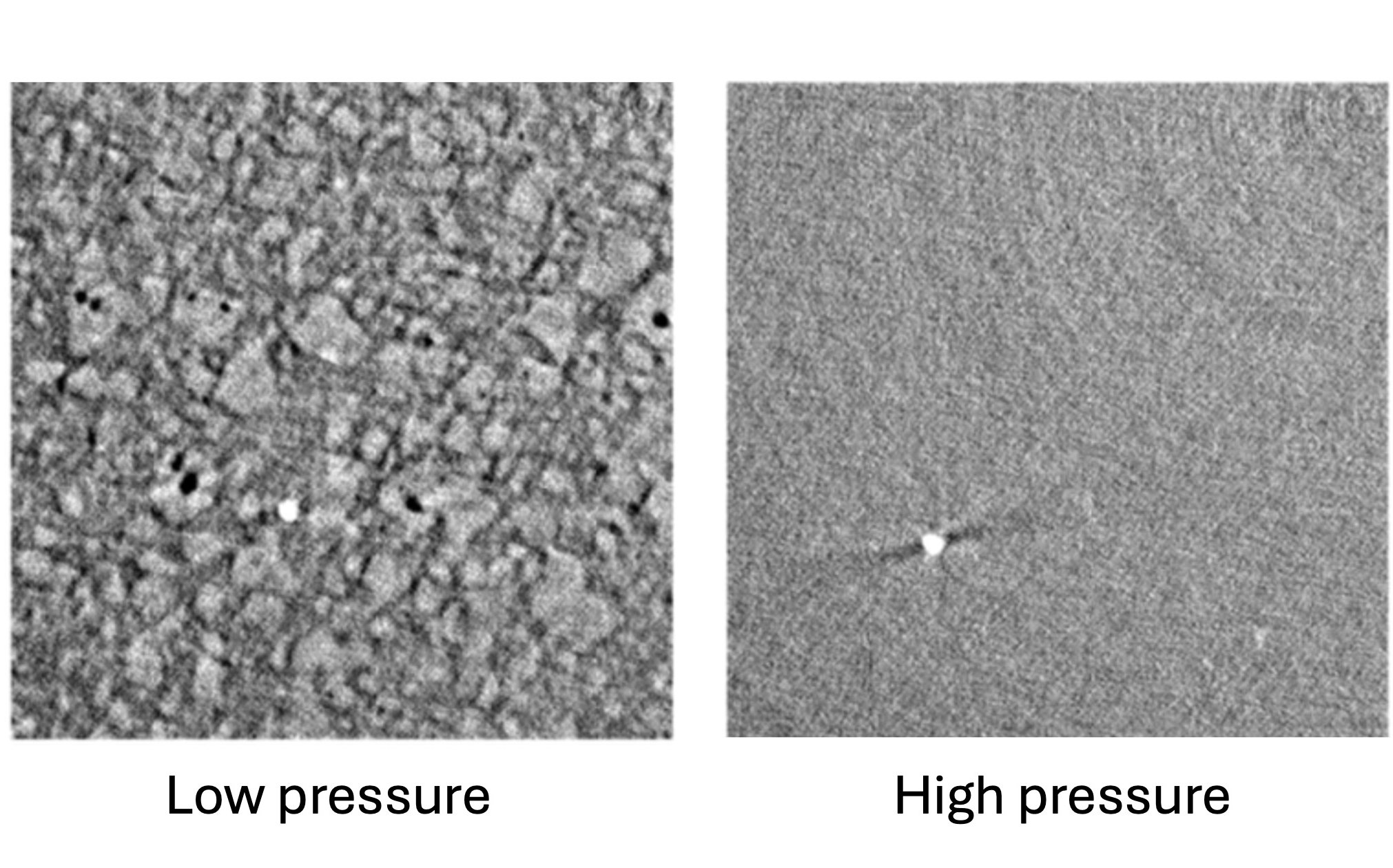
Les batteries « tout solide » sont considérées comme la prochaine avancée majeure pour le stockage d'énergie, promettant une utilisation plus sûre et une plus grande capacité de stockage. Pourtant, cette technologie se heurte à des obstacles importants, notamment des fissures qui apparaissent dans l’électrolyte solide et limitent la durée de vie de la batterie. En menant, la première étude in situ et multi-échelle des mécanismes de densification de deux électrolytes solides à base de sulfure, les auteurs ont montré que le frittage sous pression permet une densification complète des électrolytes, essentielle pour garantir la stabilité mécanique des batteries tout solide. Cette étude montre également comment les modifications microstructurales et cristallographiques sous pression influencent la circulation des ions lithium.
Solid-state batteries are considered the next major breakthrough in energy storage, promising safer operation and greater storage capacity. However, this technology faces significant challenges, including the formation of cracks in the solid electrolyte, which limit the cycling life. By conducting the first in situ, multi-scale study of the densification mechanisms of two sulfide-based solid electrolytes, the authors demonstrated that high-pressure sintering enables complete densification of the electrolytes, which is essential for ensuring the mechanical stability of solid-state batteries. This study also shows how microstructural and crystallographic changes under pressure influence lithium-ion mobility.

Mouillage de matériaux poreux par des fluides complexes
Wetting of porous media by complex fluids
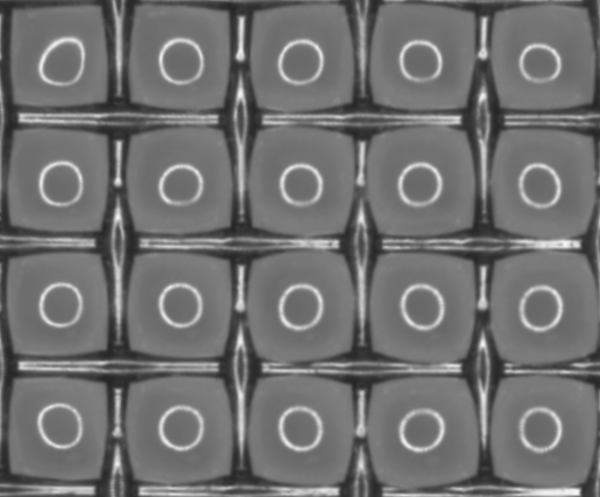
Manon Bourgade, Nicolas Bain, Loïc Vanel, Mathieu Leocmach et Catherine Barentin (équipe Liquides & Interfaces), en collaboration des collègues d’Aubervilliers, ont publié un article intitulé "Capillary and priming pressures control the penetration of yield-stress fluids through non-wetting 2D meshes" dans la revue Soft Matter. Cet article a fait l'objet d'une actualité CNRS Physique et a été repris comme fait marquant dans le livret Une année avec CNRS Physique 2025.
Manon Bourgade, Nicolas Bain, Loïc Vanel, Mathieu Leocmach and Catherine Barentin (Liquides & Interfaces team), in collaboration with colleagues from Aubervilliers, published an article entitled "Capillary and priming pressures control the penetration of yield-stress fluids through non-wetting 2D meshes" in the journal Soft Matter. This article was highlighted in the CNRS Physics news and in the booklet Une année avec CNRS Physique 2025.
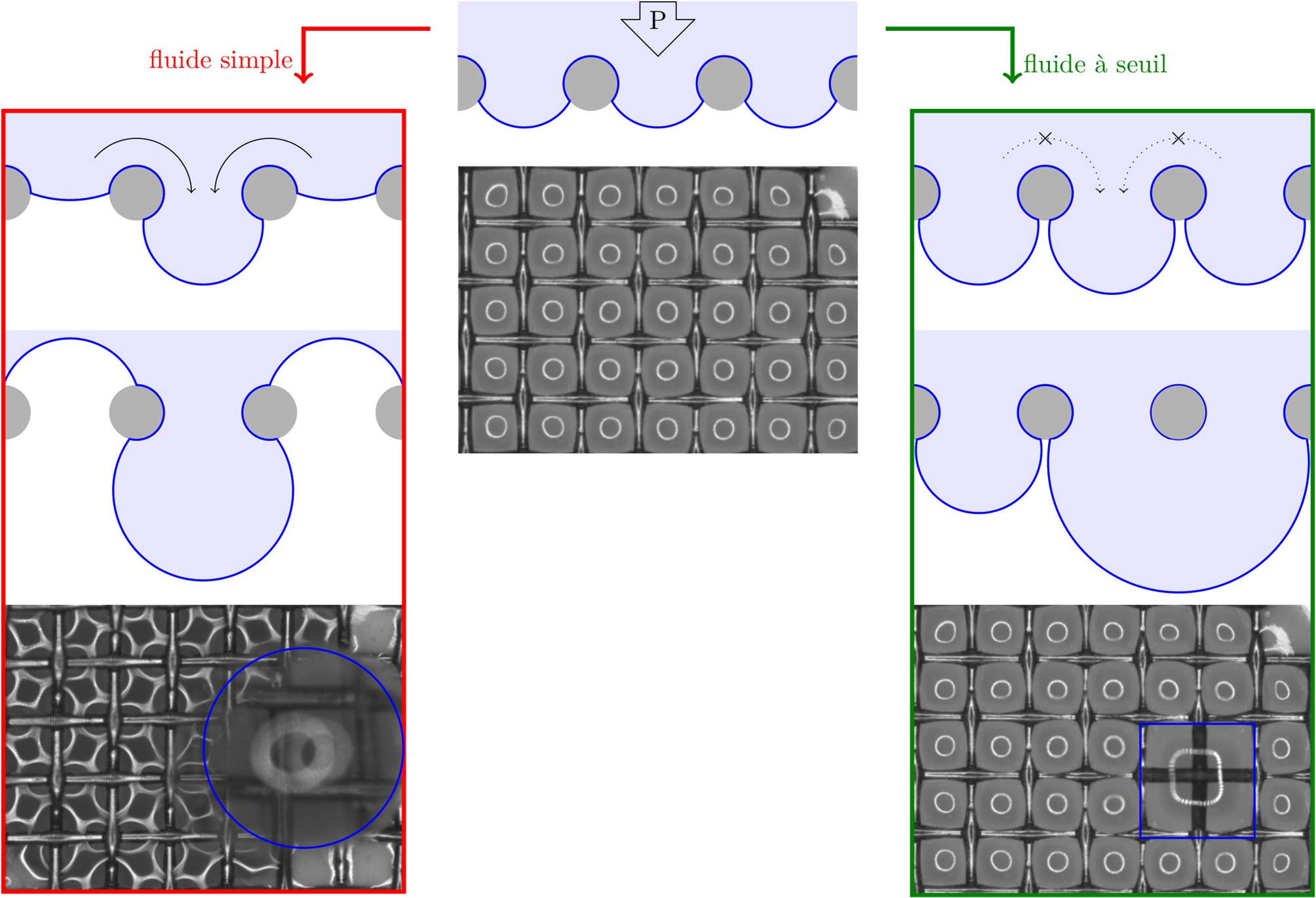
Faire pénétrer un fluide hydrophile à travers un solide poreux hydrophobe constitue un défi industriel. Si le cas des fluides simples est bien connu, celui des fluides complexes reste largement inexplorée. Dans cet article, les auteurs étudient expérimentalement la pénétration forcée d’une pâte (fluide à seuil) à travers un maillage hydrophobe, en combinant mesures de pression et visualisation directe. Ils montrent que la pénétration est contrôlée par la compétition entre les propriétés de la pâte (contrainte seuil) et deux pressions capillaires : la pression de Laplace, qui détermine le seuil à partir duquel le fluide pénètre dans le maillage, et une pression d'amorçage, qui contrôle la manière dont le fluide progresse. Cette dernière correspond à une chute de pression résultant d'une instabilité locale, jamais rapportée auparavant. Enfin, les auteurs montrent qu'une pâte pénètre de manière beaucoup plus homogène à travers un maillage hydrophobe qu'un fluide simple.
Forcing hydrophilic fluids through hydrophobic porous solids is a recurrent industrial challenge. While the penetration of simple fluids is well known, that of complex fluids remains largely unexplored. Here, the authors experimentally investigate the forced penetration of a water based paste (yield-stress fluid) through an hydrophobic mesh, combining pressure measurements and direct visualisation of the penetration process. The authors show that the penetration is controlled by a competition between the mechanical properties of the paste (yield stress) and two distinct capillary pressures: the Laplace pressure, which dictates the threshold at which the fluid penetrates the mesh, and a priming pressure, which controls how the fluid advances through it. The latter corresponds to a pressure drop ensuing a local instability, never reported before. Finally, the authors show that a paste penetrates much more homogeneously through an hydrophobic mesh as a simple liquid.