



Quand les électrons d’un métal transfèrent la chaleur au silicium
When electrons in a metal transfer heat to silicon
Michael de San Féliciano, Christophe Adessi, Julien El Hajj, François Detcheverry et Samy Merabia (équipes MMCI, Energie et Liquides et interfaces), en collaboration avec des collègues de Lyon et Reims, ont publié un article intitulé "First-principles calculations of thermal transport at metal/silicon interfaces: evidence of interfacial electron-phonon coupling" dans la revue Physical Review B. Cet article a été sélectionné comme suggestion de lecture par l'éditeur.
Michael de San Féliciano, Christophe Adessi, Julien El Hajj, François Detcheverry and Samy Merabia (from MMCI, Energy and Liquids and interfaces teams), in collaboration with colleagues from Lyon and Reims, published an article entitled "First-principles calculations of thermal transport at metal/silicon interfaces: evidence of interfacial electron-phonon coupling" dans la revue Physical Review B. This article was highlighted as an Editor’s suggestion.
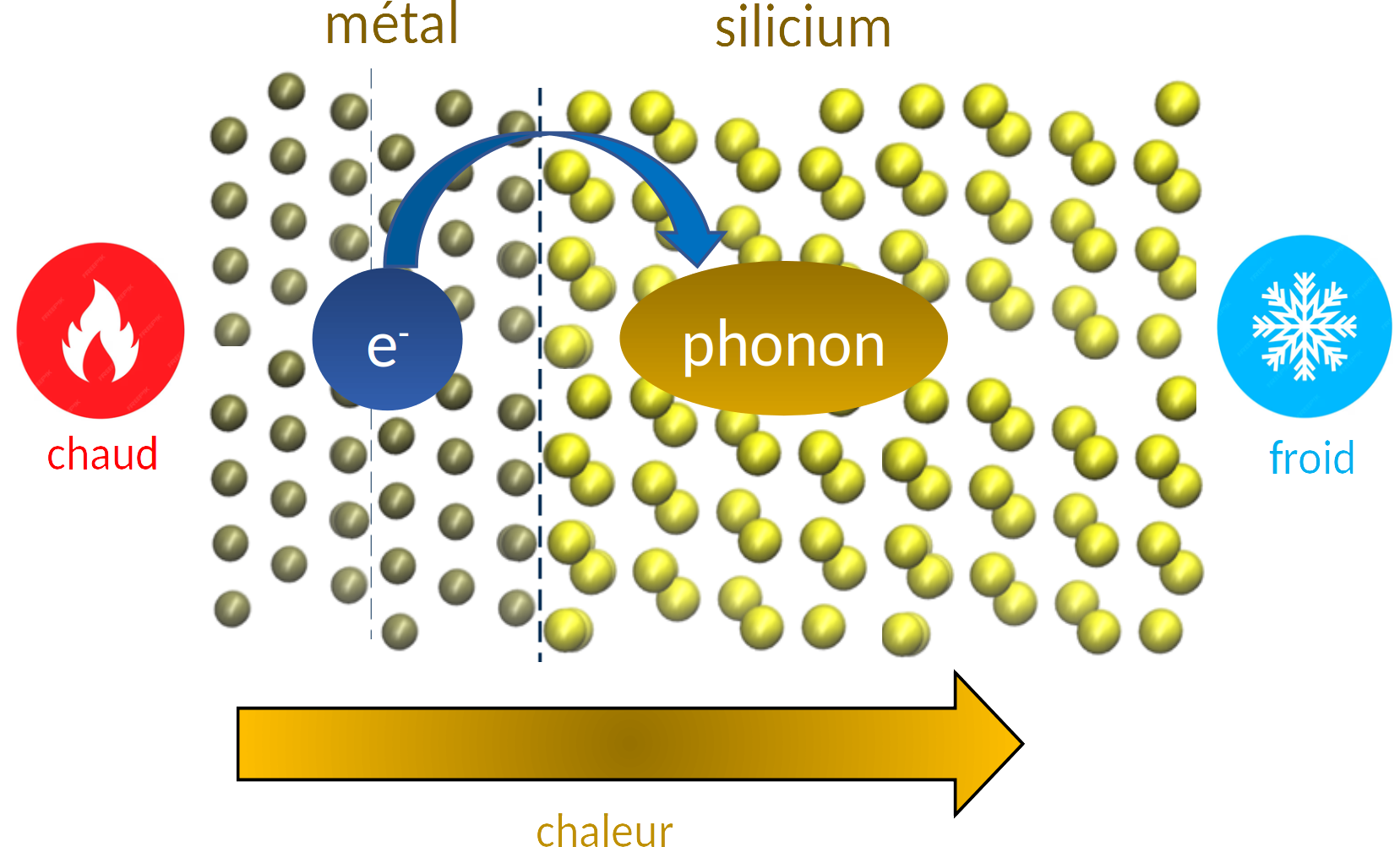
Les applications haute performance du calcul telles que l’intelligence artificielle génèrent de telles quantités de chaleur qu’il devient indispensable de réguler la température sur des échelles nanométriques. Afin de comprendre et optimiser le transport thermique entre les puces en silicium et les radiateurs métalliques, il est essentiel de comprendre le transfert de chaleur aux interfaces métal-semi-conducteur. Jusqu’à présent, il était admis que le transfert était dominé par des couplages entres les modes de vibration des matériaux (les phonons) et que les électrons du métal jouaient un rôle négligeable.
Grâce à des calculs quantiques, ce travail prédit l’existence d’un couplage électron-phonon aux interfaces métal-silicium, qui peut contribuer de manière significative au transfert de chaleur interfacial. Les auteurs montrent en particulier que l’intensité de ce couplage augmente avec la fréquence de Debye du métal, qui est une mesure de son élasticité. Les résultats de cette étude ouvrent la voie au contrôle des transferts de chaleur interfaciaux par l’intermédiaire d’effets électroniques.
Grâce à des calculs quantiques, ce travail prédit l’existence d’un couplage électron-phonon aux interfaces métal-silicium, qui peut contribuer de manière significative au transfert de chaleur interfacial. Les auteurs montrent en particulier que l’intensité de ce couplage augmente avec la fréquence de Debye du métal, qui est une mesure de son élasticité. Les résultats de cette étude ouvrent la voie au contrôle des transferts de chaleur interfaciaux par l’intermédiaire d’effets électroniques.
High-performance computing applications, such as artificial intelligence, generate enormous amounts of heat, making thermal regulation at the nanoscale essential. To understand and optimize heat transfer between silicon chips and metallic heat sinks, it is crucial to understand heat transfer at metal-semiconductor interfaces. Until now, it was assumed that heat transfer was dominated by couplings between the vibrational modes of the materials (phonons) and that metal electrons played a negligible role.
Using quantum calculations, this work the existence of electron-phonon coupling at metal-silicon interfaces, which can contribute significantly to interfacial heat transfer. The authors show, in particular, that the strength of this coupling increases with the Debye frequency of the metal, which is a measure of its elasticity. The results of this study pave the way for controlling interfacial heat transfer through electronic effects.
Using quantum calculations, this work the existence of electron-phonon coupling at metal-silicon interfaces, which can contribute significantly to interfacial heat transfer. The authors show, in particular, that the strength of this coupling increases with the Debye frequency of the metal, which is a measure of its elasticity. The results of this study pave the way for controlling interfacial heat transfer through electronic effects.


Comment observer les migrations de charges ?
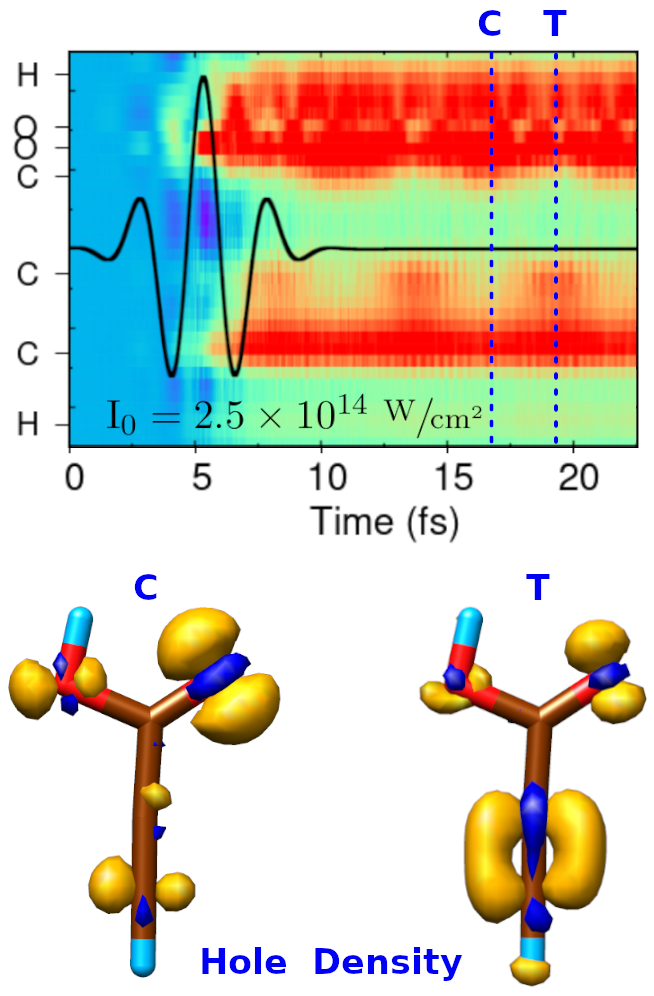
Clément Guiot du Doignon, Rajarshi Sinha-Roy, Franck Rabilloud et Victor Despré (équipe Physico-chimie théorique) ont publié un article intitulé "Correlation-driven charge migration triggered by infrared multi-photon ionization " dans la revue Chemical Science.La technologie attoseconde permet d’explorer les dynamiques électroniques à leur échelle de temps caractéristique. Les migrations de charge, dynamiques purement électroniques et ultrarapides, en constituent un exemple marquant, longtemps inaccessibles sans ces outils. Un cas clé est celui des migrations de charge corrélées, qui n’existent qu’en présence de corrélations électroniques et révèlent des effets complexes. Leur étude demeure toutefois un défi majeur, tant sur le plan expérimental que théorique. Les auteurs proposent une approche efficace en identifiant les situations où la TDDFT peut prédire de manière fiable ces dynamiques. Ils montrent qu’elles peuvent être déclenchées sélectivement par l’ionisation de molécules au moyen d’un laser infrarouge intense et suggèrent un schéma expérimental combinant ionisation par champ intense et résolution spatiale offerte par les XFELs.
How to observe charge migrations?
Clément Guiot du Doignon, Rajarshi Sinha-Roy, Franck Rabilloud and Victor Despré (Theoretical Physicochemistry team) published an article entitled "Correlation-driven charge migration triggered by infrared multi-photon ionization " in the journal Chemical Science..Attosecond technology makes it possible to explore electronic dynamics at their characteristic timescale. Charge migrations, purely electronic and ultrafast dynamics, are a striking example that remained inaccessible without these tools. A key case is that of correlation-driven charge migrations, which exist only in the presence of electronic correlations and reveal complex effects. Their study, however, remains a major challenge, both experimentally and theoretically. The authors propose an efficient approach by identifying the conditions under which TDDFT can reliably predict these dynamics. They demonstrate that such dynamics can be selectively triggered by the ionization of molecules using an intense infrared laser, and suggest an experimental scheme combining strong-field ionization with the spatial resolution offered by XFELs.


Le diamant, nouvelle électrode pour l’énergie solaire
Arsène Chemin (équipe Luminescence), en collaboration avec des collègues de Berlin, Würzburg, Freiburg et Stuttgart, a publié un article intitulé "Modulating surface redox reactions and solvated electron emission on boron-doped diamond by (photo)electrochemistry " dans la revue Physical Review X Energy.La photoélectrochimie solaire jouera un rôle clé dans la transition énergétique vers une société dé-carbonée. Pour y parvenir, il est nécessaire de développer des électrodes durables, stables et effi-caces. Le diamant dopé au bore s’impose comme un matériau prometteur : robuste, sans métal, et capable de fonctionner dans des conditions extrêmes comme la décontamination de l’eau. Les chercheurs montrent que la lumière et l’électricité peuvent agir ensemble pour contrôler des réac-tions chimiques à la surface du diamant. Selon la manière dont sa surface est préparée, il peut soit émettre des électrons solvatés qui sont de puissants réducteurs chimiques capables d’attaquer des molécules comme le CO₂, soit déclencher directement des réactions d’oxydoréduction. Cette double capacité ouvre la voie à de nouvelles applications, allant de la production d’hydrogène au stockage d’énergie solaire, en passant par la chimie verte pour un avenir plus durable.
Diamond, a new electrode for solar energy
Arsène Chemin (Luminescence team), in collaboration with colleagues from Berlin, Würzburg, Freiburg and Stuttgart, published an article entitled "Modulating surface redox reactions and solvated electron emission on boron-doped diamond by (photo)electrochemistry " in the journal Physical Review X Energy..Solar photoelectrochemistry will play a key role in the energy transition towards a decarbonized society. To achieve this goal, durable, stable, and efficient electrodes must be developed. Boron-doped diamond emerges as a highly promising material: robust, metal-free, and capable of operating under extreme conditions such as water decontamination. The researchers demonstrate how light and electricity can work together to control chemical reac-tions at the diamond surface. Depending on its surface termination, diamond can either emit solvat-ed electrons – powerful chemical reducers capable of attacking molecules like CO₂ – or directly trigger redox reactions. This dual capacity opens new perspectives for applications ranging from hydrogen production and solar energy storage to green chemistry for a more sustainable future.


