



Le diamant, nouvelle électrode pour l’énergie solaire
Arsène Chemin (équipe Luminescence), en collaboration avec des collègues de Berlin, Würzburg, Freiburg et Stuttgart, a publié un article intitulé "Modulating surface redox reactions and solvated electron emission on boron-doped diamond by (photo)electrochemistry " dans la revue Physical Review X Energy.La photoélectrochimie solaire jouera un rôle clé dans la transition énergétique vers une société dé-carbonée. Pour y parvenir, il est nécessaire de développer des électrodes durables, stables et effi-caces. Le diamant dopé au bore s’impose comme un matériau prometteur : robuste, sans métal, et capable de fonctionner dans des conditions extrêmes comme la décontamination de l’eau. Les chercheurs montrent que la lumière et l’électricité peuvent agir ensemble pour contrôler des réac-tions chimiques à la surface du diamant. Selon la manière dont sa surface est préparée, il peut soit émettre des électrons solvatés qui sont de puissants réducteurs chimiques capables d’attaquer des molécules comme le CO₂, soit déclencher directement des réactions d’oxydoréduction. Cette double capacité ouvre la voie à de nouvelles applications, allant de la production d’hydrogène au stockage d’énergie solaire, en passant par la chimie verte pour un avenir plus durable.
Diamond, a new electrode for solar energy
Arsène Chemin (Luminescence team), in collaboration with colleagues from Berlin, Würzburg, Freiburg and Stuttgart, published an article entitled "Modulating surface redox reactions and solvated electron emission on boron-doped diamond by (photo)electrochemistry " in the journal Physical Review X Energy..Solar photoelectrochemistry will play a key role in the energy transition towards a decarbonized society. To achieve this goal, durable, stable, and efficient electrodes must be developed. Boron-doped diamond emerges as a highly promising material: robust, metal-free, and capable of operating under extreme conditions such as water decontamination. The researchers demonstrate how light and electricity can work together to control chemical reac-tions at the diamond surface. Depending on its surface termination, diamond can either emit solvat-ed electrons – powerful chemical reducers capable of attacking molecules like CO₂ – or directly trigger redox reactions. This dual capacity opens new perspectives for applications ranging from hydrogen production and solar energy storage to green chemistry for a more sustainable future.


De nouveaux capteurs de température
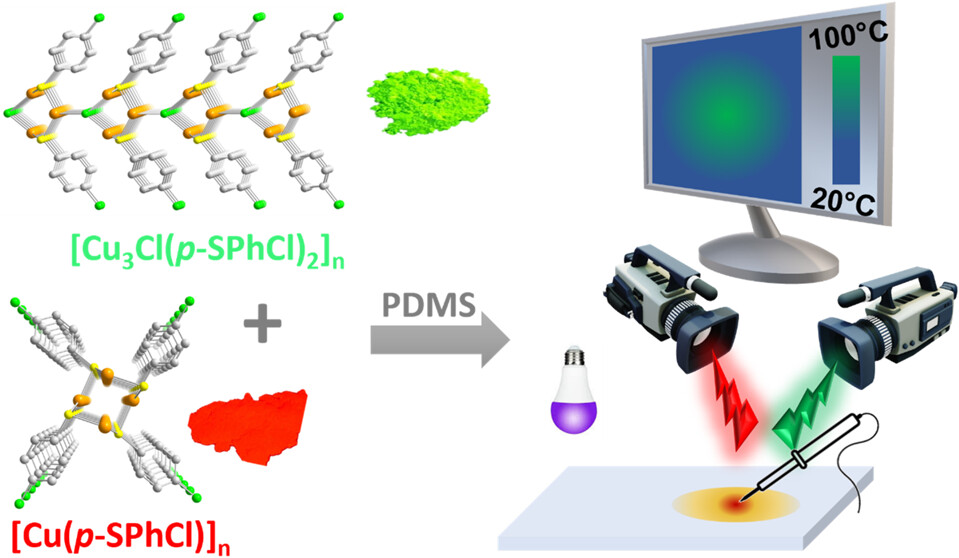
Antoine Bérut, Loïc Vanel (équipe Liquides et interfaces) et Gilles Ledoux (équipe Luminescence), en collaboration avec des collègues de Lyon, ont publié un article intitulé "Copper(I)–thiolate coordination polymers for in situ temperature sensing in PDMS " dans la revue ACS Applied Materials & Interfaces.De la recherche biomédicale à la cuisson parfaite du soufflé, la température est une grandeur physique que l’on a souvent besoin de mesurer avec précision. Cependant, dès lors que l’on veut mesurer des processus rapides et à petite échelle, la plupart des capteurs de température usuels se trouvent limités. Les sondes thermiques (thermocouples, thermistances), qui doivent être mises en contact avec l’échantillon, ne peuvent pas toujours être miniaturisées, et les méthodes optiques usuelles (comme les caméra infrarouges) sont souvent cantonnées à des vitesse d’acquisition relativement lentes. Les auteurs ont développé et testé de nouveaux éléments photo-émissifs, de quelques microns, qui soumis à un éclairage UV, émettent un signal lumineux qui dépend de la température, avec un temps de réponse de l’ordre de la milli-seconde. En les combinant au sein d’une matrice polymère, ils ont montré que ces éléments pouvaient être utilisés comme capteurs de température, avec une bonne résolution spatiale et temporelle. Plus amusant, les auteurs ont montré qu’en jouant sur les proportions d’éléments photo-émissifs dispersé au sein de la matrice, il était possible de reconstruire toutes les couleurs du spectre visible, comme avec les composantes RGB sur les pixels d’un écran.
New luminescent sensors for temperature measurement
Antoine Bérut, Loïc Vanel (Liquids and Interfaces team) and Gilles Ledoux (Luminescence team), in collaboration with colleagues from Lyon, published an article entitled "Copper(I)–thiolate coordination polymers for in situ temperature sensing in PDMS " in the journal ACS Applied Materials & Interfaces..From biomedial research to mastering the art of soufflé in pastry cooking, temperature is a physical quantity that one often needs to measure with precision. However, when high temporal and spatial resolutions are required, traditional temperature sensors often fail. On one hand, thermal probes (such as thermocouples and thermistor), which needs to be in contact with the sample, cannot always be miniaturized. On the other hand, infrared cameras, are often limited when it comes to high speed image acquisition. The authors have developed and tested new photo-emissive elements, with a size of a few microns, which emits a temperature depend light signal under UV lighting, with a response time of a few milliseconds. By combining those elements in a polymer matrix, they have shown that those elements can serve as thermal sensors with a good spatial and temporal resolution. On a funnier note, they have also shown that, by playing with the proportion of each element dispersed in the matrix, it is possible to reconstruct every visible color, as with the RGB components in a computer screen pixel.


Activité chiroptique d’une nanoparticule
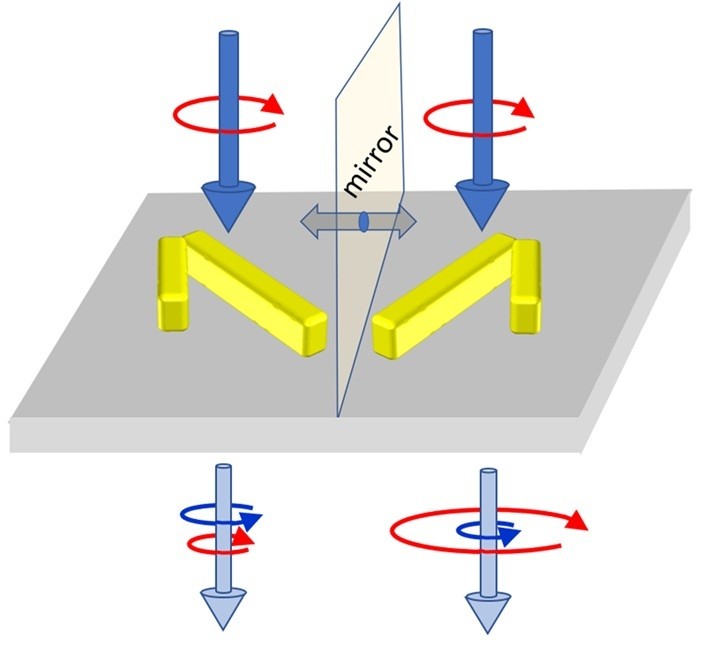
Marius Gauchet, Floriane Perrier, Christophe Bonnet, Marie-ange Lebeault, Emmanuel Cottancin, Jean Lermé et Michel Pellarin (équipe Agnano), ont publié en collaboration avec des collègues de Troyes, un article intitulé "Bright field polarimetry of a single plasmonic nanostructure combining polarization and position modulation techniques" dans la revue ACS photonics, .Mesurer et comprendre les propriétés chiroptiques de nanoparticules métalliques individuelles constitue un enjeu important dans le domaine de la nanophotonique. Il s’agit d’abord de comprendre les mécanismes fondamentaux responsables de la manifestation du dichroïsme circulaire dans le domaine visible, en lien avec la chiralité et la réponse plasmonique de ces objets. D’autre part, c’est une étape essentielle dans la conception de métamatériaux nanostructurés construits à partir de ces briques élémentaires et susceptibles de modifier l’état de polarisation de la lumière, de manière contrôlée et efficace. Nousavons développé une approche innovante permettant de caractériser de manière complète l’anisotropie optique d’un nano-objet unique : dichroïsmes circulaire et linéaire ainsi que les biréfringences associées. La méthode, son cadre théorique d’application et le protocole de traitement des données expérimentales sont illustrés ici par l’étude de deux systèmes modèles : des dimères achiraux de nano-sphères d’or et des structures chirales en or fabriquées par lithographie électronique sur substrat transparent.
Chiroptic activity of a single nanoparticle
Marius Gauchet, Floriane Perrier, Christophe Bonnet, Marie-ange Lebeault, Emmanuel Cottancin, Jean Lermé & Michel Pellarin (Agnano team), in collaboration with colleagues from Troyes, published an article entitled "Chiroptic activity of a single nanoparticle " in the journal ACS photonics. .Measuring and understanding the chiroptical properties of individual plasmonic nanoparticles, is a major issue in the field of nanophotonics, .The first aim is to understand the basic mechanisms responsible of the appearance of circular dichroism in the visible rage, in relation with the chirality and the plasmonic response of these objects. On the other hand, this is an essential step for designing nanostructured metamaterials built from these elementary units, which could modify the polarization state of light, in a controlled and efficient way. We developed a novel approach allowing the full characterization of the optical anisotropy of a single nano-object: circular and linear dichroisms, and related birefringences. The method, its theoretical background, and the protocol of experimental data processing are illustrated here by the study of two model systems: achiral dimers of gold nanospheres and chiral gold structures synthesized by electron beam lithography on a transparent substrate.