

















Phase transition and metastability
Members
- Frédéric Caupin
- Jean Colombani
- Sylvain Deville
- Bruno Issenmann
- Stella Ramos-Canut
- Olivier Vincent
Phase transitions are involved in many key physical processes and we seek a microscopic understanding of their role. Our studies address a variety of systems, that includes the metastability of supercooled water, the condensation in porous materials, the dissolution and cristallisation of minerals, the evaporation of droplets and the solidification processes in frozen materials.
Highlights
Very cold water flows twice as well under pressure

Unlike other liquids, water under pressure flows with less friction: its viscosity decreases. This anomaly, discovered by Röntgen 140 years ago, gets more pronounced at low temperatures. To find out to what extent, researchers from the Institute of Light and Matter undertook measurements of viscosity under pressure in supercooled water, i.e. still liquid at temperatures at which ice is more stable. In 2017, in a first experiment, they were able to flow water through a pipe measuring 9 thousandths of a millimeter, reaching 3000 times atmospheric pressure and 19°C below the melting temperature of ice. To go further, they built a second experiment where the water no longer flows. It is the spontaneous agitation of suspended beads which gives access to the viscosity of the water. These beads are so small (less than a thousandth of a millimeter) that they cannot be seen under a microscope, but their movement is perceptible in the fluctuations of the light passing through the suspension. This experiment confirms the previous one, and extends the viscosity measurements in water 30 °C below the melting temperature of ice. A pressure of the order of 1000 times atmospheric pressure then reduces friction by half.
Viscosity and Stokes-Einstein relation in deeply supercooled water under pressure. Mussa et al., J. Chem. Phys. (2023)
When bubbles chase drops

Drop breakup is often associated with boiling or violent impacts onto targets. We report on experiments where the decrease of ambient pressure triggers the growth of a bubble in a drop that sits on a textured hydrophobic surface. We find a transition from top-breakup to triple-line breakup depending on the initial contact angle of the drop, which is captured by a model based on inertial dynamics.
Depressurization-induced drop breakup through bubble growth. Pirat et al., Physical Review Fluids (2023)
Unveiling cells’ local environment during cryopreservation
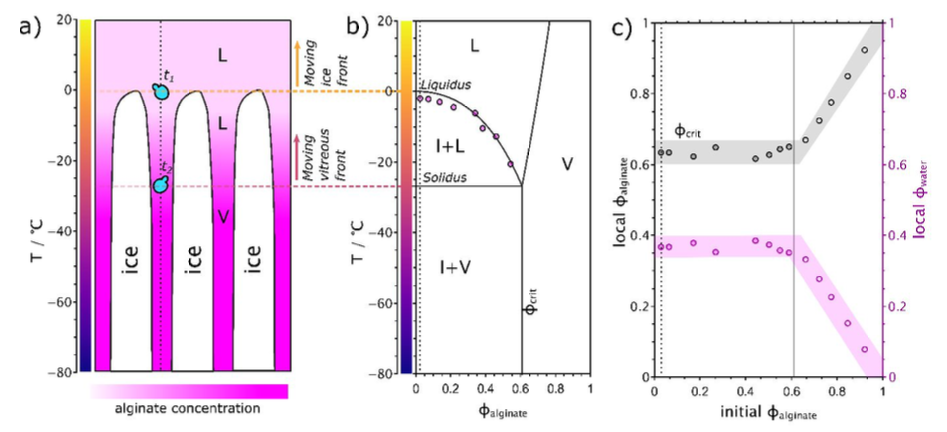
We couple in situ microscopic directional freezing to visualize cells and their surroundings during freezing with the freezing-medium phase diagram. Our correlative strategy may be applied to cells relevant to clinical research and practice and may help in the design of new cryoprotective media based on local physicochemical cues.
Unveiling cells’ local environment during cryopreservation by correlative in situ spatial and thermal analyses. Qin et al., J Phys Chem Lett (2020)
Objects interacting with a solidification front
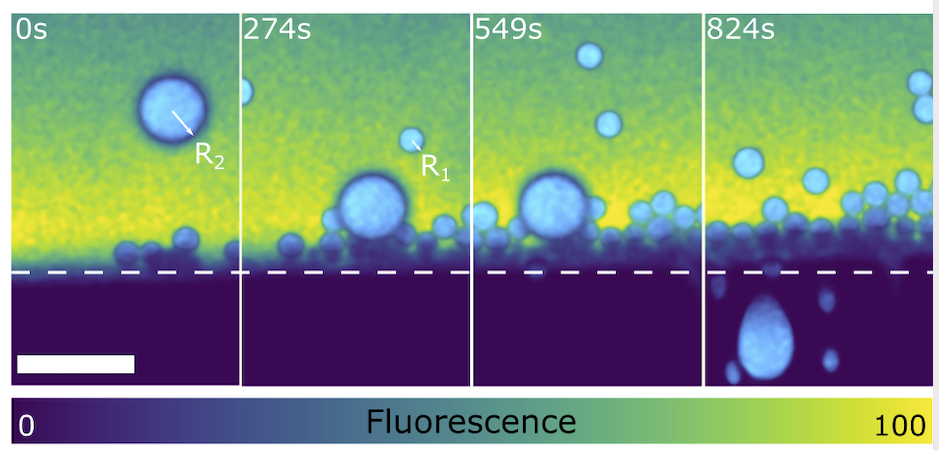
We show the interaction of multiple oil droplets with an ice-water front in the absence and presence of solute effects using in situ cryo-confocal microscopy. We report on how the object size, number of objects, and bulk solute concentration influence the the object-front interaction and the front morphology, as well as the subsequent object spatial distribution.
Multiple objects interacting with a solidification front, Tyagi et al., Scientific Reports (2020).
Atome probe tomography of frozen liquids
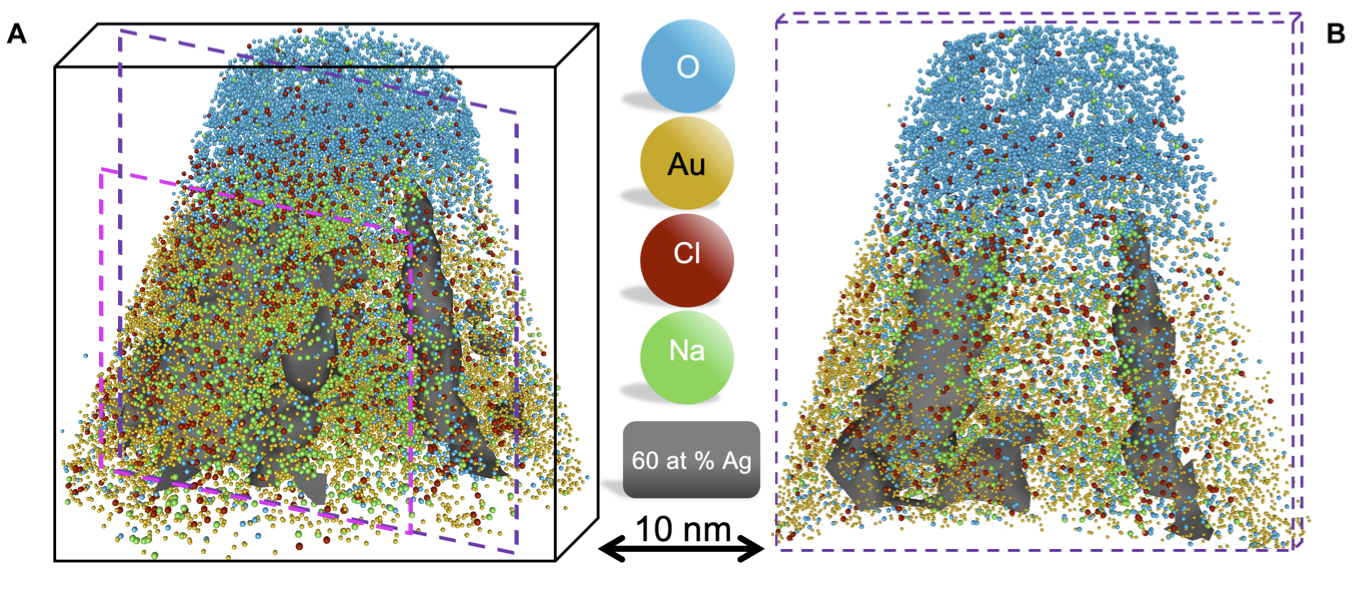
We used atom probe tomography to analyze frozen liquids in three dimensions with subnanometer resolution. Our study demonstrates the viability of using frozen water as a carrier for near-atomic–scale analysis of objects in solution by atom probe tomography.
Enabling near-atomic–scale analysis of frozen water, El-Zoka et al., Science Advances (2020)
Calcite growth under stress
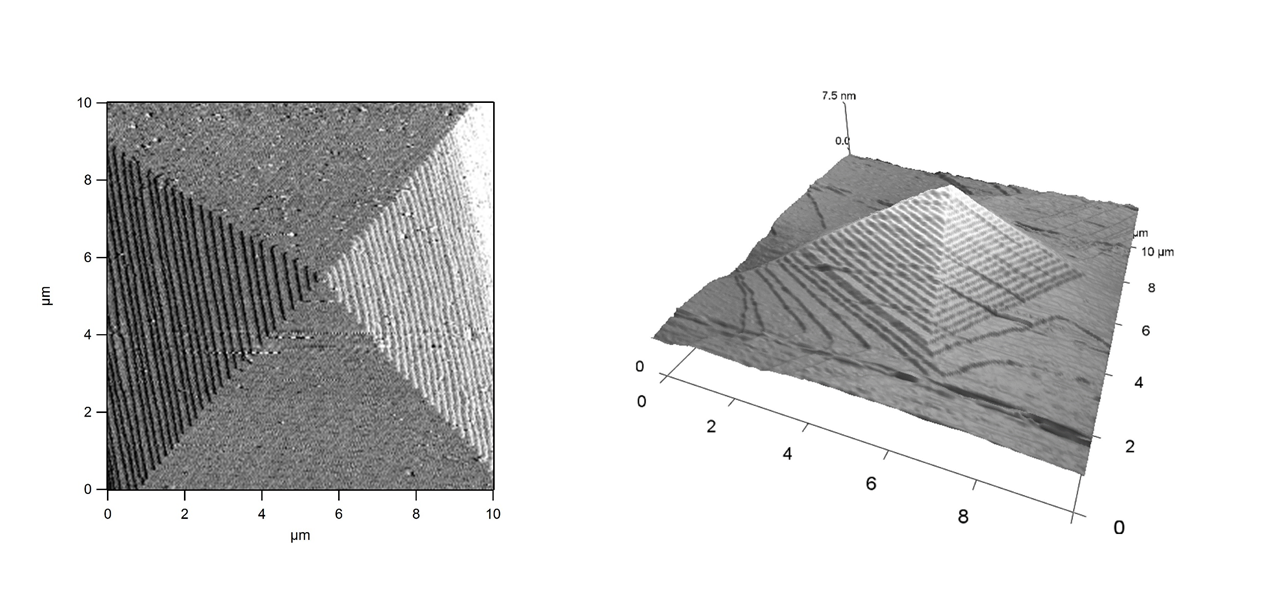
We have shown, with Atomic Force Microscopy measurements, that the application of a stress during the growth of a calcite crystal induces a slowdown of the growth kinetics, and even a change of the growing crystalline phase.
Tuning biotic and abiotic calcite growth by stress, Zareeipolgardani et al., Crystal Growth Des. (2019).
Salt tunnels formed by the evaporation of a drop
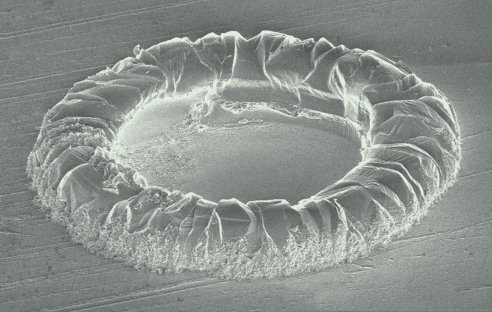
We have observed thin salt shells that form at the periphery of evaporating pure water drops on salt. Shell shapes range from rings of inclined walls to hollow toroidal rims. We have interpreted this phenomenon as a consequence of a molecular coffee-stain effect by which the dissolved salt is advected toward the pinned contact line where an increased evaporation drives the crystallization of the shell.
Hollow rims from water drop evaporation on salt substrates, Mailleur et al., Phys. Rev. Lett. (2018)
Freezing water droplets on heated highly hydrophobic surface
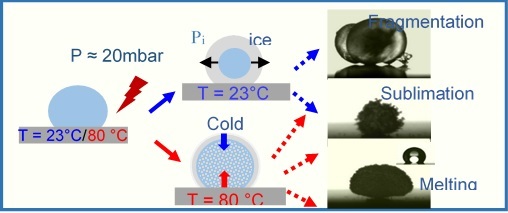
We experimentally study the freezing process of water drops and its temporal stability on highly hydrophobic surfaces. Main results: (i) three different mechanisms influenced by the substrate’s temperature, lead to the disappearance of the frozen droplets. A “Cassie ice state” can be reached. (ii) instabilities and convective cells are observed on heated substrates.
Stability of frozen water droplets on highly hydrophobic porous surfaces: Temperature effectsRamos et al., Appl. Surf. Sc. (2018).
The more, the swifter
Commuting during rush hours teaches us that the denser the crowd, the slower the motion. In contrast, increasing pressure in water makes it denser, but less viscous! At 20°C, the effect is modest. By supercooling water to -29°C, we find that viscosity drops by nearly one half for a 2000 atm pressure increase. We propose an explanation based on a two-state model.
Pressure dependence of viscosity in supercooled water and a unified approach for thermodynamic and dynamic anomalies of water, L.P. Singh et al., PNAS (2017).
Drop evaporation on superhydrophobic surfaces
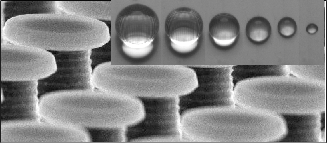
We experimentally study the evaporation of drops on heated superhydrophobic surfaces decorated with micrometer-sized mushroom-like pillars.The drop evaporation appears to be controled by the contact line dynamics. Main results (i) in the pinned regime, the substrate heating promotes the contact line depinning; (ii) in the moving regime, the droplet motion is described by periodic stick−slip events and contact-angle oscillations (iii) remarkable stability of the “fakir” state to the temperature.
Water drop evaporation on mushroom-like super-hydrophobic surfaces..., Marcelo do Nascimento et al., Langmuir (2016)