

















Interfacial transport and nanofluidics |
|
The team is recognized in the field of nanohydrodynamics and electrokinetics for having developed experimental tools that allow to probe the dynamics of fluids at the nanoscale. Among them, nanorheology is probed by SFA and AFM, and very small flow rates (fL/s) have been recently measured via Coulter counting or confocal microscopy (dye profile analysis). With these tools, we explore fluid transport in single nanopores, nanotubes or nanochannels obtained from nano-fabrication techniques or more complex self-assembled structures such as soap films.
One goal is to investigate the unexpected properties that emerge at the nanoscale and to focus on the particular liquid/surface interaction on the flow properties. Recent projects involve flow probes coupled to static surface characterization in collaboration with ONLI team for example. Applications of these studies are numerous in material science engineering and energy recovery processes. |
|
Members: Biance, Anne-Laure Colombani,Jean |
|
Highlights |
Solute enrichment in nano channel: flow effectsA novel flow-induced effect in nanochannels resembling electric-field-induced concentration polarization is reported. A pressure-driven flow modifies the solute concentration inside channels, generating gradients from homogeneous initial conditions. Combining FCS measurement, theoretical and numerical modeling, we quantitatively describes this ubiquitous phenomenon and show how it can be harnessed for ultra-sensitive mass transport measurement in single nanochannel. Flow-induced shift of the Donnan equilibrium..., Gravelle et al., J. Chem. Phys. (2019) |
|

Osmotic-capillary competition in plant-like, multiscale nanostructuresWe studied multiscale (micro/nano) porous media that resemble the architecture of water-conducting vessels in plants. We investigated how these structures spontaneously fill or empty under humidity cycles when they contain solutes. The competition between nanoscale liquid-vapor equilibria, osmosis and capillarity gives rise to a variety of unexpected filling/emptying regimes as a function of driving force. How solutes modify the thermodynamics and dynamics..., Vincent et al., Langmuir (2019) |
|

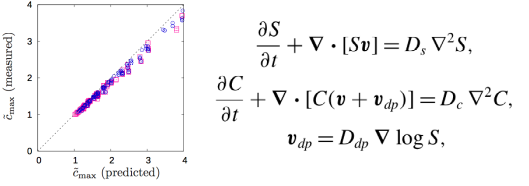
Diffusiophoretic effects in mixingPursuing investigations of phoretic effects in the transport and mixing of suspended particles, we explore the coupling between linear flows and diffusio- or thermophoretic drift. This analytically tractable problem allows pointing remarkable properties of phoretic particle transport, such as the compressible nature of the particle velocity field, in close analogy with the transport of inertial particles. Advection and diffusion in a chemically induced compressible flow, Raynal et al. J. Fluid Mechanics (2018) |
Maximum phoretic focusing for different flows characteristics. |
The subtle mechanisms dictating osmotic flowsWe continue our work on peculiar (diffusio-)osmotic transport. Looking at silica surface response to either poly(ethylene)glycol polymers or ethanol solute gradient. Strikingly, both neutral solutes yield osmotic flows in the usual low to high concentration direction, in contradiction with their propensity to adsorb on silica. This emphasizes the complex role of near-surface dynamics for understanding the osmotically-driven flows. Nanoscale dynamics vs surface interactions..., Lee et al., J. Phys. Chem. Lett. (2017) |
Diffusio-osmotic flows in single nanochannels: a subtle interplay between molecular scale solute dynamics and surface interactions. |

The strange fate of capillary filling at nanoscaleMolecular Dynamic Simulations were used to study the filling velocity or capillary pressures found in carbon nanotubes (CNTs) down to the single file molecular regime. Strikingly, the filling behavior shows strong deviation to macroscopic theory down to molecular scales. This is illustrated by confinement-induced wettability reversal as shown in the present figure. Very elegantly, these effects are purely geometric and can be rationalized with the use of the disjoining pressure associated to the liquid structuration. Anomalous capillary filling and wettability reversal ..., Gravelle et al., Phys. Rev. E (2016) |
Example of water capillary rise in carbon nanotubes. Wettability reversal by minute radius changes |

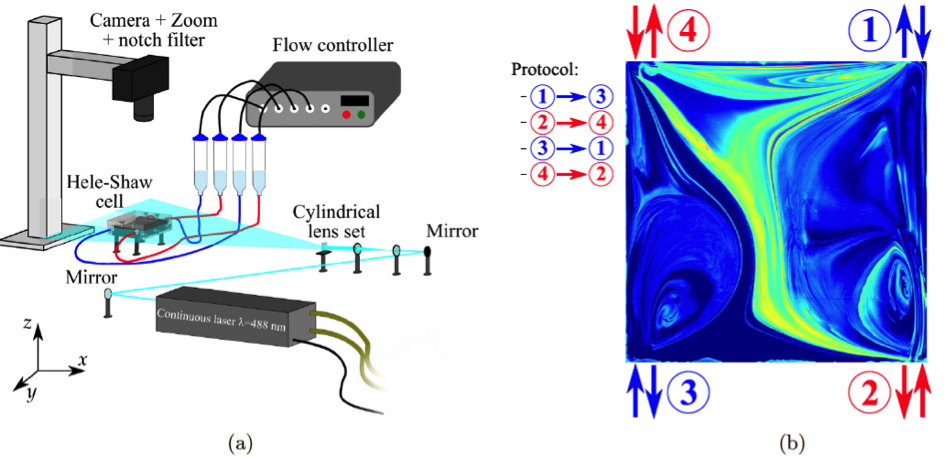
Diffusiophoresis in macroscale mixingWe pursue our studies on chaotic mixing of environment-sensing particles in collaboration with our colleagues at ENS de Lyon and LMFA. Exploring chaotic advection flows at macro-scale, we demonstrate that nanoscale diffusiophoresis can trigger global changes in the mixing behavior. Remarkably, diffusiophoresis is shown to affect all scales, although more particularly the small ones, resulting in a change of scalar intermittency and in an unusual scale bridging spanning more than seven orders of magnitude. Diffusiophoresis at the macroscale, Mauger et al. Phys. Rev. Fluids (2016). |
Chaotic mixing in Hele-Shaw cell: Altered transport of particles bye unerlying salt gradients. |
More highlights |