

















Active matter and materials
Members
- Nicolas Bain
- Cécile Cottin-Bizonne
- François Detcheverry
- Mathieu Leocmach
- Christophe Ybert
When many individuals are put together some spectacular collective effects can emerge such as flock of birds, swarms of bacteria, human crowds. Many efforts have recently attempted to create artificial systems mimicking their living counterpart. Active matter is a new class of complex systems, composed of particles that are made "active" through a local conversion of energy to create self-propulsion, which drives these systems very far from thermal equilibrium. This generates complex behaviors far richer than in equilibrium materials.
We experimentally study active soft matter and more particularly the spontaneous structure and dynamics of semi-dilute and dense active colloidal structures. We are also interested in driven active matter: particles that have the ability to bias their motion in response to an external stimuli, indeed the ubiquitous ability of living active matter to bias its motion is of key importance in observed collective motions.
Highlights
Universal dispersion of bacteria
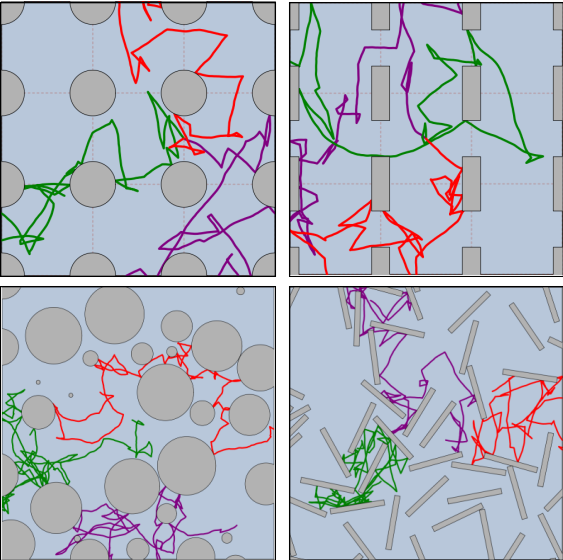
The Earth is populated by swimming micro-organisms, such as bacteria, which move around randomly and inhabit porous environments, such as sediments, soils or animal bodies. Predicting the dispersal of bacteria in these environments is a relevant problem in many contexts, whether it be infection of the human body, contamination of food or pollution of aquifers.
The difficulty lies in the enormous diversity of situations encountered, both in the type of bacteria and in the structure of the porous medium. This work shows that the dispersion of bacteria is in fact surprisingly predictable, due to a geometric property known as Cauchy invariance. Behind the apparent diversity lies a universal law.
Universal law for the dispersal of motile microorganisms in porous media, Pietrangeli et al., Phys. Rev. Lett. (2025).
Collective oscillations in human crowds

While dense crowds constitute one of the most dangerous environments in modern society, our current understanding of their dynamics relies primarily on heuristic collision models. The emergent dynamics of dense crowds, composed of thousands of individuals, however, remains a formidable many-body problem that lacks quantitative experimental characterisation and explanations rooted in first principles.
In this study, Nicolas Bain and colleagues from Lyon and Pamplona analyse the dynamics of thousands of individuals at the San Fermín festival (Spain) and derive a physical theory of dense crowds in a confined environment. The measurements reveal that dense crowds can self-organise into macroscopic chiral oscillators, coordinating the orbital motion of hundreds of individuals without external guidance. Guided by conservation laws and symmetry principles, the authors construct a mechanical model that shows that emerging frictional forces lead to a phase transition towards collective chiral oscillations, in perfect agreement with all their experimental observations.
Emergence of collective oscillations in massive human crowds, Gu et al., Nature (2025).
Does active matter exhibit capillarity?
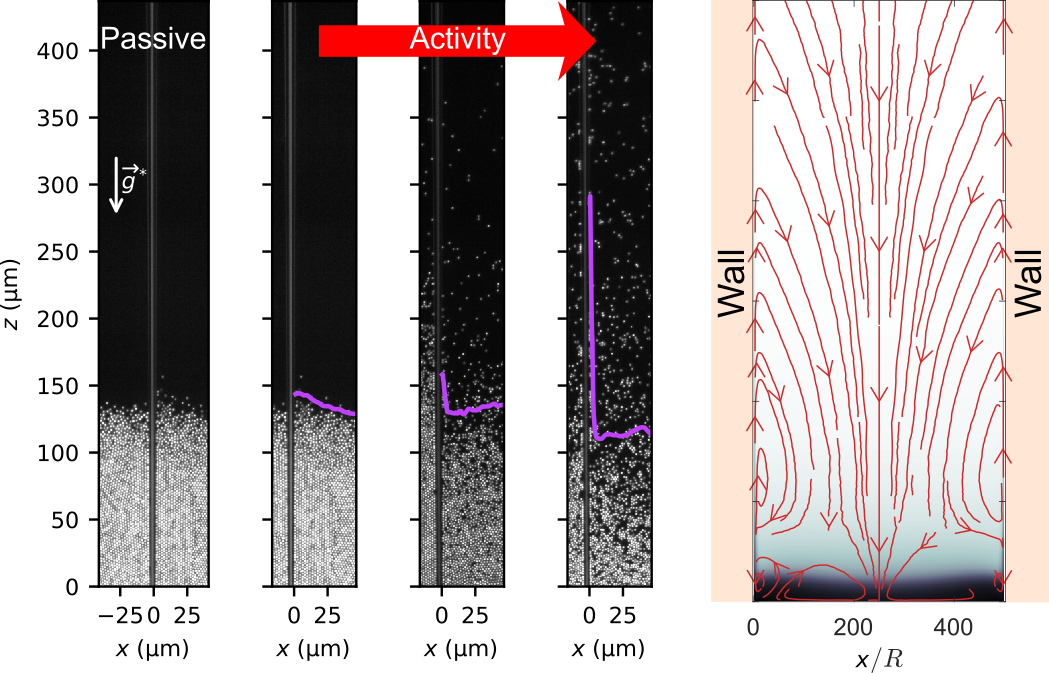
Water rises against gravity when put in contact with a vertical wall. To create an active version of this experiment, we use a suspension of self-propelled colloidal particles. Without fuel, the sediment does not wet the wall. In presence of fuel, the particle self-propell and climb the wall. Surprisingly, this climbing occur when the self propulsion is too weak to create a real interface having an interfacial tension. Contrary to passive wetting, we do not observe a meniscus but a one-particle-thick adsobed layer. In that layer, the particles point up, actively climbing against gravity. This phenomenon has no analog in passive systems. Thanks to a collaboration with specialists in numerical simulations in Germany, we have shown in which conditions a vertical wall is able to create a constant flux against gravity, and thus work from microscopic units.
How to steer active colloids up a vertical wall, Fins-Carreira et al., Nature Communications (2024).
Marangoni forces in interfacial swimmers
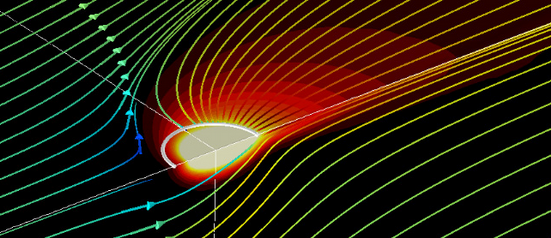
We use numerical methods to investigate the role of Marangoni forces in the propulsion velocity of a symmetric interfacial swimmer. We find that their influence is crucial near the swimming instability but much less in the regime well above the threshold.
Role of Marangoni forces in the velocity of symmetric interfacial swimmers, Boniface et al., Phys. Rev. Fluids (2021).
When self-propulsion slows down a glass
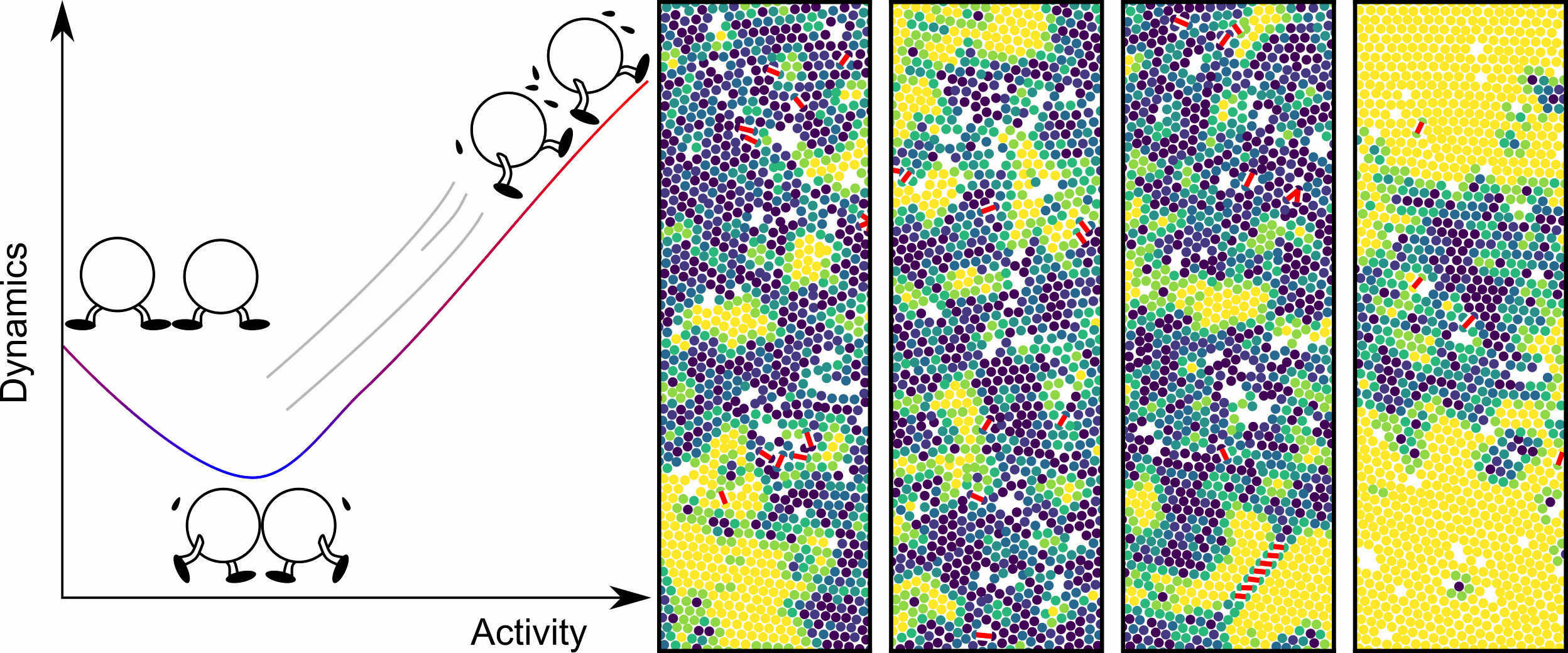
We study experimentally the rearrangements of a dense crowd of microparticles able to self-propel. Unexpectedly, weak directional motion slows down rearrangements, even if strong self-propulsion actually fludifies the system. This effect stresses the importance of disordered agitation to fluidify a crowd or a tumour.
Active glass: ergodicity breaking dramatically affects response to self-propulsion, Klongvessa et al., Phys. Rev. Lett. (2019).
Camphor disks are isotropic objects yet self-propel
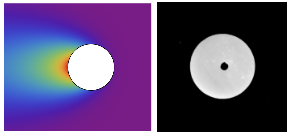
While an isotropic object, a disk releasing surfactant such as camphor spontaneously sets into motion, making it a simple interfacial swimmer. We propose a point-source model to explain the symetry-breaking mechanism at play and compare the predictions on velocity to experiments.
Self-propulsion of symmetric chemically active particles: Point-source model and experiments on camphor disks, Boniface et al., Phys. Rev. E (2019).
Swim polarization in sedimenting active colloids
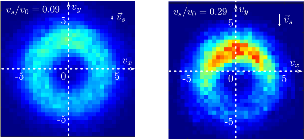
Carefully controlling the sedimentation of our active colloids and gathering statistics on their instantaneous velocities, we were able to experimentally demonstrate the orientational swim polarization predicted some years ago. A good opportunity to confront experimental figures with theoretical predictions on sedimenting profiles and pressure(s) build up
Sedimentation of self-propelled Janus colloids: polarization and pressure.., Ginot et al., New J. Phys. (2018).
Active clusters
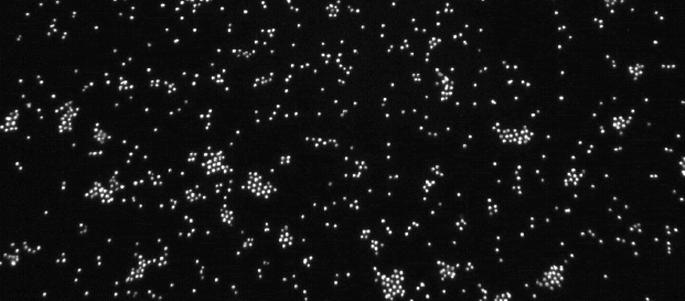
An assembly of self-propelled particles can self-organize into a "cluster phase". Those clusters transient groups that appears spontaneously, they can merge, break and exchange particles continuously. Combining high-statistics experi-mental data and the predictions of a simple model, we provide the first complete description of the active cluster phase.
Aggregation-fragmentation and individual dynamics of active clusters, Ginot et al., Nature Communications (2018).
Random walks of swimming bacteria
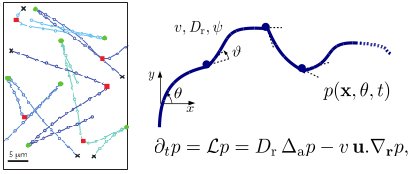
Swimming bacteria exhibit a variety of motion patterns, in which persistent runs are punctuated by sudden turning events. The statistical properties of these random walks have been established for the particular case where the turning events follow a Poisson process. Extending the framework of continuous-time random walks, we show how to treat the general, non-Poissonian case.
Generalized run-and-turn motions: From bacteria to Lévy walks, Detcheverry F., Phys. Rev. E (2017).
Driven active matter: magnetotactic bacteria

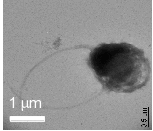
We explore the behavior of magnetotactic bacteria as a benchmark system of driven active matter that offers great capabilities for physical and quantitative investigations. Such bacteria synthetize a permanent magnet, that can be easily remotely controlled by a magnetic field that orients the motion of the bacteria. We characterize the bacteria motion when facing a Poiseuille flow and evidence some structuring capabilities of active matter.
Destabilization of a flow focused suspension of magnetotactic bacteria, Waisbord et al., Phys. Rev. Fluids (2016).